


If you’ve ever spotted a large, dark fly circling your horse, you may have wondered whether it was an unusually big housefly or something else entirely. Horse flies are among the largest biting flies you’ll encounter around barns, pastures, and riding trails. Some are large enough to be noticed from several feet away.
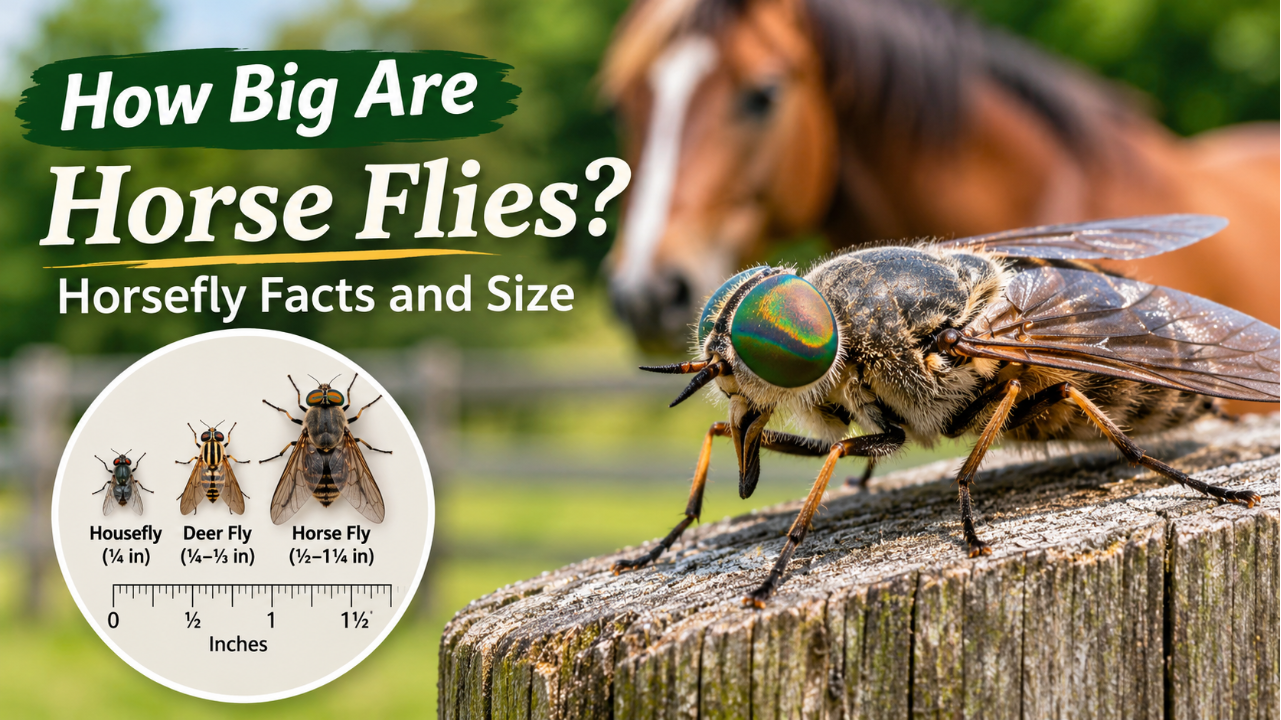
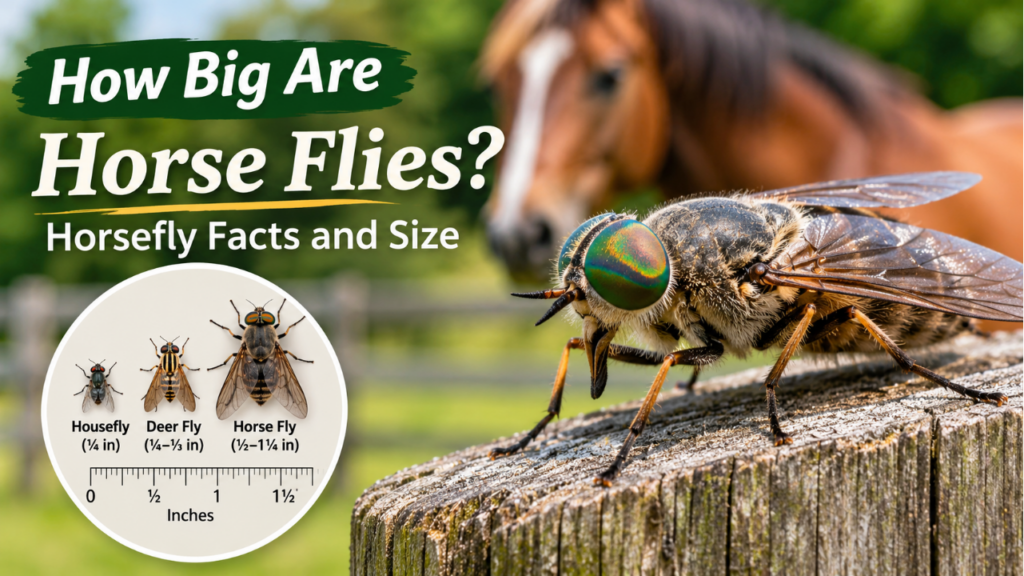
Most adult horse flies measure between ½ and 1¼ inches (12–32 mm) long, although some species can grow considerably larger. That makes many horse flies roughly two to three times the length of a typical housefly.
Their size is only part of what makes them distinctive. Horse flies also have large eyes, powerful wings, and, in females, sharp mouthparts capable of delivering a painful bite.
Here’s how big these insects actually get, how to identify different horse flies, and what horse owners should know when they appear.
How Big Is a Horse Fly?
Horse flies vary considerably in size depending on the species. Most adults fall between ½ and 1¼ inches long, according to Purdue University’s Department of Entomology.
For a quick comparison, a smaller horse fly might be about the length of a housefly or slightly larger. A typical large horse fly can approach the length of a quarter’s diameter, while exceptionally large species may reach nearly two inches.
Horsefly Size Chart
| Type of fly | Approximate body length |
|---|---|
| Housefly | ¼ inch (6–7 mm) |
| Deer fly | ¼–⅓ inch (6–8 mm) |
| Typical horse fly | ½–1¼ inches (12–32 mm) |
| Exceptionally large horse fly | Up to about 2 inches (50 mm) |
The larger individuals are particularly noticeable because of their heavy bodies and broad wings. Unlike a slender mosquito, a horse fly has a solid, muscular appearance.
One important detail: photographs can be misleading. A close-up image of a small horse fly may make it look enormous, especially when there is no familiar object beside it.
To judge its actual size, compare the insect with a coin or ruler rather than relying on a magnified photograph.
What Do Horse Flies Look Like?
A horse fly looks somewhat like an oversized housefly, but several features help distinguish it.
The most obvious is its head. Horse flies have exceptionally large compound eyes that occupy much of the head’s surface. Depending on the species, these eyes may appear black, brown, metallic green, or even patterned with colorful horizontal bands.
Their bodies are typically dark brown, black, or gray, although some have lighter markings along the abdomen.
Five Features That Help Identify a Horse Fly
1. Large, prominent eyes
The eyes are often the easiest feature to recognize. Some species have striking iridescent colors that are especially visible in photographs.
2. A broad, sturdy body
Horse flies have thick bodies that look more substantial than those of common houseflies. Larger species can appear almost bee-sized.
3. One pair of strong wings
Their wings are usually clear, smoky, or uniformly tinted. Some related flies have distinctive dark wing patterns.
4. Short antennae
Unlike mosquitoes, horse flies have relatively short, sturdy antennae.
5. Noticeable mouthparts
Female horse flies have cutting mouthparts that project downward from the head. These allow them to slice through skin rather than simply puncture it.
Size alone isn’t enough for a definite identification. The shape of the eyes, wings, antennae, and body all matter.
Pictures of Horse Flies: Small, Large, and Giant Species
Not every horse fly looks alike. The horse fly family, Tabanidae, includes numerous species with different sizes, colors, and markings.
Some are grayish insects that could easily be mistaken for ordinary flies. Others are large, nearly black insects that are difficult to overlook.
Black Horse Fly
The black horse fly (Tabanus atratus) is one of the largest and most recognizable horse flies in North America.
It has a predominantly black body, dark wings, and enormous eyes. Particularly large individuals can approach two inches long.
Because of its size and dark appearance, this species is often the insect people have in mind when they describe seeing a giant horse fly.
Its appearance may be intimidating, but it doesn’t actively hunt people. Female black horse flies primarily seek blood meals from large mammals.
Common Horse Flies
Many horse flies in the genera Tabanus and Hybomitra are smaller than the black horse fly.
They often have brown or gray bodies, large colorful eyes, and clear or slightly smoky wings.
These are the kinds of horse flies commonly encountered in pastures, wooded areas, and near wetlands.
Although smaller than the largest species, they can still deliver painful bites.
Deer Flies
Deer flies are close relatives of horse flies and belong to the same family.
They’re generally smaller, usually around ¼ to ⅓ inch long. Many have yellowish or brown bodies, colorful eyes, and distinctive dark markings across their wings.
If a small, persistent fly keeps circling your head along a wooded trail, it may be a deer fly rather than a horse fly.
Both insects bite, but their appearance and preferred feeding locations can differ.
Horse Fly vs. Housefly: What’s the Difference?
Horse flies are often mistaken for oversized houseflies, particularly when they’re resting on walls, fences, or windows.
The differences become easier to recognize once you know what to look for.
| Feature | Horse fly | Housefly |
|---|---|---|
| Body size | Usually ½–1¼ inches | About ¼ inch |
| Build | Large and robust | Smaller and compact |
| Eyes | Very large, sometimes colorful | Usually reddish |
| Wings | Clear or smoky | Clear |
| Bites | Females can bite painfully | Does not bite |
| Common habitat | Pastures, wetlands, wooded areas | Buildings, garbage, animal facilities |
The biggest difference for horse owners is feeding behavior.
Houseflies generally feed on exposed liquids and organic material. Their mouthparts aren’t designed to cut through skin.
Female horse flies, however, feed on blood. They’re particularly attracted to large mammals, making horses and cattle frequent targets.
If you’ve watched a horse suddenly kick, stamp, or whip its tail at a large fly, there’s a good chance it was responding to a biting insect such as a horse fly.
How Big Can the Largest Horse Fly Get?
Some horse flies grow much larger than the average adult.
The University of Wisconsin Extension notes that particularly large species, including the black horse fly, can reach approximately two inches in body length.
To put that into perspective, two inches is roughly the length of a standard house key.
An insect that size can look surprisingly large when it lands on a horse’s leg or flies past your face.
However, giant horse flies aren’t necessarily the most aggressive toward humans. Host preferences vary among species, and some large horse flies primarily target livestock.
It’s also important to distinguish body length from wingspan. An insect with its wings spread may look much wider than its actual body measurement.
Are Female Horse Flies Bigger Than Males?
Male and female horse flies look similar, and size differences depend on the species. You can’t reliably determine a horse fly’s sex just by deciding which one looks bigger.
A more useful distinction is the position of their eyes.
In many species, male horse flies have eyes that meet or nearly meet at the top of the head. Female horse flies typically have a visible space separating their eyes.
Their feeding habits are also different.
Female horse flies bite animals and people. Male horse flies do not feed on blood.
Both sexes consume plant sugars such as nectar, but females of many species need a blood meal to develop their eggs.
That means the horse fly biting your horse is a female.
Why Do Horse Flies Bite Horses?
Horses are attractive targets because they’re large, warm-blooded animals that spend considerable time outdoors.
Female horse flies locate potential hosts using several clues, including movement, body shape, dark colors, and carbon dioxide.
Once a female lands, she uses specialized mouthparts to cut into the skin.
Unlike mosquitoes, which insert needle-like mouthparts, horse flies create a small wound and feed on the blood that emerges.
This explains why their bites can be particularly painful.
Horses often respond by stamping their feet, swishing their tails, twitching their skin, or trying to move away.
Some flies continue returning after being interrupted, making them especially frustrating during turnout or riding.
According to the Merck Veterinary Manual, horse flies may feed around the legs, underside of the abdomen, neck, and withers.
Heavy fly activity can interfere with grazing, resting, and normal behavior.
Where Do Horse Flies Live?
Horse flies occur in many parts of the world, but they’re particularly common near water and moist environments.
Their preferred habitats include:
- Marshes and wetlands
- Ponds, streams, and riverbanks
- Damp pastures
- Wooded areas
- Low-lying fields with saturated soil
The connection to water is important because many species spend their immature stages in aquatic or semi-aquatic environments.
Adult horse flies can travel away from their breeding sites, however, so you don’t necessarily need a pond on your property to encounter them.
When Are Horse Flies Most Active?
In much of the United States, horse fly activity increases during warmer months, particularly late spring and summer.
Exact timing varies with geography, weather, and species.
These insects generally feed during daylight hours and are often especially noticeable in warm, sunny conditions.
For horse owners, that may mean greater fly pressure during summer turnout, trail rides, and outdoor training sessions.
How Big Are Baby Horse Flies?
Baby horse flies don’t look like miniature adults.
Horse flies undergo complete metamorphosis, developing through four stages: egg, larva, pupa, and adult.
Eggs: Females lay clusters of small, elongated eggs, often on vegetation overhanging water or moist ground.
Larvae: After hatching, the larvae enter water, mud, or damp soil. They’re elongated, legless, and somewhat maggot-like.
Pupae: Mature larvae eventually pupate before emerging as winged adults.
Adults: Fully developed horse flies emerge with wings and the familiar large-eyed appearance.
Larvae vary in length as they grow, so there isn’t one standard measurement for a baby horse fly.
Unlike adult females, larvae don’t visit horses to feed on blood. Many are predators of small organisms living in moist soil or aquatic habitats.
Depending on the species and environmental conditions, development can take months or even several years.
Are Big Horse Flies Dangerous?
The main immediate problem with horse flies is their painful bite.
Their cutting mouthparts can leave small wounds that may continue bleeding briefly after the insect flies away.
Horses may also develop localized swelling or skin irritation.
Most isolated bites aren’t serious, but repeated attacks can cause considerable discomfort and stress.
There is also a veterinary concern. Horse flies can mechanically transmit certain pathogens when they move between animals while feeding.
One important example is equine infectious anemia, or EIA, a viral disease of horses.
Mechanical transmission means the insect can carry infected blood on its mouthparts from one animal to another. It doesn’t mean every horse fly is infected or that every bite transmits disease.
The Merck Veterinary Manual identifies horse flies among the potential mechanical transmitters of EIA and certain other animal diseases.
If your horse develops unexplained fever, weakness, or other signs of illness, contact your veterinarian rather than assuming the symptoms are simply a reaction to fly bites.
How to Protect Your Horse From Horse Flies
Completely eliminating horse flies from an outdoor property is difficult, especially when nearby wetlands provide breeding habitat.
However, several practical steps may help reduce your horse’s exposure.
Use Physical Fly Protection
Fly sheets, masks, and appropriate leg protection can help shield vulnerable areas.
Choose breathable equipment that fits properly and doesn’t cause rubbing.
Provide Accessible Shelter
A shaded barn, run-in shed, or other sheltered area gives horses somewhere to escape heavy fly activity.
Some horses naturally seek indoor shelter when biting flies become persistent.
Adjust Turnout When Necessary
If horse flies are particularly active during certain daytime periods, consider modifying turnout or exercise schedules.
Observe conditions on your own property, since fly activity varies throughout the season.
Consider Horse Fly Traps
Certain traps use large dark objects to attract horse flies.
These may reduce local fly numbers in some situations, but results vary. They’re not a guaranteed solution for an entire pasture.
Use Fly Repellents Realistically
Horse fly repellents may provide limited or temporary relief.
Because these insects spend relatively little time resting on the host, some treatments are less effective against them than against other flies.
Use only products specifically labeled for horses, and follow the manufacturer’s instructions.
For persistent infestations or severe reactions, ask your veterinarian about additional management options.
Frequently Asked Questions About Horsefly Size
How Big Is a Horse Fly Compared to a Mosquito?
A typical horse fly is substantially larger and heavier than a mosquito. While many mosquitoes measure only a few millimeters long, most adult horse flies are approximately 12–32 mm long.
Can Horse Flies Be Two Inches Long?
Yes. Some exceptionally large horse flies, including black horse flies, can approach two inches in body length. However, most species are considerably smaller.
Are All Large Flies Horse Flies?
No. Robber flies, bot flies, and other large insects may resemble horse flies at first glance. Check the eyes, body shape, wings, and mouthparts before identifying one.
Do Horse Flies Bite Humans?
Yes. Females of some horse fly species bite humans as well as animals. Their bites can be painful and may cause swelling or irritation.
What Is the Biggest Difference Between Horse Flies and Deer Flies?
Size and wing markings are useful clues. Horse flies are generally larger and often have clear or uniformly tinted wings. Deer flies are usually smaller and commonly have patterned wings.
Final Thoughts
Horse flies are much bigger than the ordinary flies most people encounter around their homes. While most measure between ½ and 1¼ inches long, exceptional individuals can approach two inches.
Their large eyes, sturdy bodies, and powerful wings make them relatively easy to recognize once you know the distinguishing features.
For horse owners, identifying these flies matters for more than curiosity. Female horse flies deliver painful bites, and heavy activity can make horses uncomfortable in the pasture or during exercise.
Understanding their size, appearance, and behavior is a useful first step toward recognizing them and protecting your horse during fly season.