


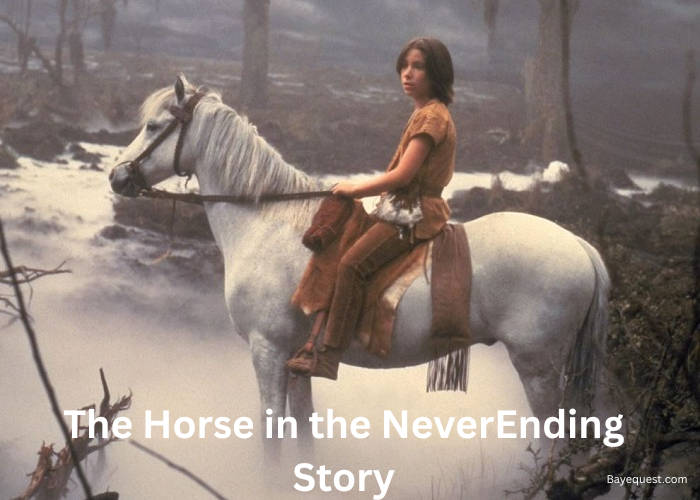
You remember the scene. The black water, the boy screaming, the reins going slack.
You probably do not remember the name.
The horse in The NeverEnding Story is called Artax. He belongs to Atreyu, and he dies in the Swamps of Sadness about a third of the way into the 1984 film.
That part is easy.
The harder part is the thing many of you have carried since childhood. The belief that the horse really drowned. That the crew let it happen. That what you watched was not acting at all.
That rumour has outlasted forty years, two generations, and a director who denied it on the record more than once.
We went through the oral histories, the production record, and the interviews the cast gave decades later. Below is who Artax was, how the scene was actually built, what happened to the horses afterwards, and who on that set really got hurt.
It was not the horse.
The Horse in the NeverEnding Story: Key Takeaway
The heartbreaking Artax scene in The NeverEnding Story was carefully staged, and no horse died during filming. A trained horse stood on a controlled hydraulic platform, while the real danger happened elsewhere on set. Noah Hathaway, the young actor playing Atreyu, suffered serious injuries during production.
Artax: The Grey Horse Who Belongs to Atreyu
Artax is not scenery. He is the only friend Atreyu has for the entire first act.
Atreyu is a young warrior from the Plains People, chosen by the Childlike Empress to find a cure for her illness while a force called the Nothing eats Fantasia from the edges inward. Artax carries him out of the Grasslands and into the quest.
The two of them leave together, alone, with no map and no adult supervision. That is the entire premise of the first hour.
The film spends real screen time on them before it takes one away.
Artax also does something quieter for the story. Atreyu is a child being sent to save a world, and a boy alone on foot reads as lost. A boy on a horse reads as a warrior.
Take the horse away and Atreyu is exactly what he was underneath the whole time. Small, wet, and on his own.
The film knows this. That is why the swamp comes first, before the Oracle and before Falkor.
On screen, Artax is a grey. Two near-identical grey mares played him, and the crew swapped between them so neither animal worked too long in a single day.
His breed is the one thing nobody can pin down.
Some sources describe an Arabian and Welsh Cob type. The Neverending Story wiki names a grey Connemara for the 1990 sequel. Other accounts say American Quarter Horse.
No production record settles it, so we are not going to pretend one does. If you have read a confident answer somewhere, it was a guess wearing a confident voice.
The name gets mangled too. People write Artex, or search the phrase “horse in never ending story” because the word will not come back to them.
That is normal. The scene burned in. The name did not.
Interesting read: Badass Horse Names You Will Love.
What Actually Happens in the Swamps of Sadness
The film tells you the horse is going to die before the horse dies.
Bastian reads the rule out loud from the book, in the voice you probably heard it in as a child: “Everyone knew that whoever let the sadness overtake him would sink into the swamp.”
That is not throwaway narration. It is the mechanism, announced in advance, and then demonstrated on someone you like.
Atreyu is crossing the swamp for a practical reason. Morla the Ancient One lives on the far side, and Morla is the first stop on the road to the Southern Oracle.
So the swamp is not a trap he stumbles into. He rides in on purpose, knowing what it is.
Here is the cruel part of the design. Atreyu wears the Auryn, the amulet the Childlike Empress gave him, and it protects him completely. Artax has nothing.
The boy is safe. The horse is not. Neither of them can trade places, and neither of them chose it.
The swamp does not grab or pull or drag anyone under. It takes whoever stops believing there is any point in moving.
So Artax does not drown the way animals drown in other films. He stops.
Atreyu tries everything a person can try. He pulls on the reins. He gets into the water. He shouts at a horse to fight against the sadness, which is both useless and exactly what a frightened child would do.
He calls him a stupid horse. He does not mean it, and it does not help.
None of it works, and the scene runs long enough that you understand none of it is going to work. That is the actual injury. Not the death, the helplessness in front of it.
The pacing is deliberate. Petersen lets the shots run past the point of comfort, and there is no rescue cut, no last-second reprieve, no music swelling to tell you it will be alright.
Most family films from 1984 would have thrown Falkor in at that moment. This one just keeps the camera where it is.
Then the camera cuts.
The last thing the film gives you is a crying child holding a rein with nothing on the end of it.
Did the Horse in The NeverEnding Story Really Die? No, and Here Is the Evidence
No horse died making The NeverEnding Story. Both animals that played Artax walked off the set unharmed. The sinking was created with two trained mares, a hidden mechanical platform, and a hard limit that kept the water at chin height.
Director Wolfgang Petersen said so directly in an Entertainment Weekly oral history, quoted here by CBR: “The horse did not really die, despite what has been said throughout the years. First of all, we had two identical white horses that played Artax… It took months to train them.”
He went further in a separate oral history for Nerdist, and this is the part that settles it for us.
“We all dreaded filming that scene, with Artax going down,” Petersen said. “It took weeks and weeks for the handlers of the horses to train them to go down and not be afraid.”
Then: “None of us liked to shoot it, to be honest. It was so sad and still when I see the movie I have to take a deep breath before I watch the scene.”
Read that again. The rumour assumes a callous crew. The crew hated making it, and the director still cannot watch it comfortably decades later.
It is also worth knowing what kind of production this was. The film cost 60 million Deutsche Marks, roughly $25 to $27 million at the time, which made it the most expensive film ever made in Europe when it went into production.
Films at that budget do not improvise with livestock on a soundstage in Munich. They hire handlers and build rigs, which is precisely what this one did.
So why will the story not die?
Three reasons. The first is that the scene is simply more convincing than any denial. A quote in an interview cannot compete with a memory that vivid.
The second is timing. It spread in the years before the internet, passed between kids face to face, in the same era that produced the “ghost” in Three Men and a Baby and the supposed hidden word in The Lion King. Den of Geek makes this point well. Nobody could check anything, so everybody believed everything.
The third is happening right now. A new audience is meeting the scene as a clip on TikTok. No context, no commentary, no ending attached. The rumour gets a fresh generation every few years.
Facts alone have not killed it. So let us show you the machine instead.
How They Built the Sinking Scene at Bavaria Studios
There was no swamp.
The Swamps of Sadness were a set of linked water basins on a soundstage at Bavaria Studios in Munich, where most of the film was shot. Crews packed peat and planted vegetation over the joins between basins so the landscape reads as one continuous marsh on camera.
Almost none of Fantasia was a real place. The production shot its real-world scenes in Vancouver and its beach sequence at Playa de Mónsul in southern Spain, and built the rest indoors.
One of the larger basins was built differently. It held a hidden hydraulic platform that could be lowered under the surface.
The horse stood on the platform. The platform sank. The horse did not.
That single sentence is the whole trick, and it is why the rumour is impossible.
The training took roughly seven weeks with a professional horse handler. Both mares learned to stand still as the water came up, and to descend without fighting it.
Noah Hathaway, who played Atreyu, put it plainly: “they spent a couple of months teaching her to be ok with being up to her neck with water.”
Petersen described the same process as “weeks and weeks.” Published figures range from seven weeks to a couple of months, so treat it as a range rather than a fixed number.
Two limits governed the shot. The water never came above chin height, because no horse tolerates more than that and the shot never needed it.
And the camera cuts away before the face reaches the mud.
Sit with that one.
The most famous image in the film is one the film never shows you. You built it yourself, as a child, in the half second after the cut. You have been carrying your own invention ever since and blaming Wolfgang Petersen for it.
None of this was unusual for the production. Falkor, the luck dragon, was a full-size practical creature lying on the stage with around twenty puppeteers hidden in the floor beneath him.
“One guy was responsible for the nose,” Petersen told Nerdist, “another for the eyes, another for the tongue.”
That is the house style. Build the thing, hide the machinery, point a camera at it.
The swamp sequence took more than two and a half weeks to shoot for a few minutes of finished screen time, with the two mares rotating between takes so neither spent long in the water.
That is not a production cutting corners with an animal. That is a production spending two and a half weeks being careful with one.
The Horse Was Fine. The Boy Riding Him Was Not.
Somebody did get badly hurt on The NeverEnding Story. It was the child.
During a rehearsal, Noah Hathaway was thrown and trampled by a horse. He broke two lower vertebrae and spent around two months in traction in a German hospital, according to coverage of his own account. The back problems stayed with him for life.
That was not the only incident.
In the shot where Falkor pulls Atreyu out of the muck, the production used dry ice for atmosphere. Dry ice sinks, and it pushed the breathable air off the surface.
Hathaway lost consciousness under it. Crew had to clear the gunk out of his mouth.
Petersen wanted his young actors doing their own stunts so the film would feel real. It did feel real. This is what it cost.
Hathaway has since summed up the whole shoot in nine words: “they were more careful with that horse than they were with me.”
He has also talked about the long financial tail of those injuries. Aggregator coverage has put his medical costs at around $800,000, sourced to his own statements, so we would treat the figure as reported rather than confirmed.
The relationship on set was not warm either. Petersen told Nerdist he “didn’t care for so much” about Hathaway because of an attitude and parental demands during production, which is a striking thing to say about a boy who broke his back making your film.
Hathaway won the Saturn Award for Best Performance by a Younger Actor in 1985 for the role. He was rewarded for a performance that cost him two vertebrae, and then he largely disappeared from the conversation about the film.
The point stands either way.
For forty years, an animal cruelty story has been attached to the one participant on that set who was never actually in danger. The person who got hurt broke his back in rehearsal, off camera, and almost nobody tells that story at all.
What Happened to the Two Horses After Filming
One of them got a very good retirement.
When the shoot wrapped, the production gave Noah Hathaway one of the two mares as a gift, along with her saddle. That is a generous thing to hand a child actor, and also an impractical one.
He was living in the United States. Shipping a horse home from a German shoot was never going to happen, and he was too young to arrange it even if it had been.
So she went to his riding double instead, the man who had doubled for him on horseback throughout production. He kept her on a ranch in Germany, near where the film was made.
She lived there for more than twenty years and died of natural causes.
For a horse, that is a full life and then some. She was already a trained adult working animal when the cameras rolled in 1983.
Take a second with the arithmetic on that.
The horse a generation quietly mourned spent the next two decades in a Bavarian field, well fed and thoroughly retired, while the rumour about her death travelled the world without her.
The second mare is a genuine blank. No interview or production record we found says where she went, which is unsatisfying but honest. She finished the film in the same condition she started it, and after that the paper trail stops.
In Michael Ende’s Book, Artax Talks the Whole Time He Is Sinking
The novel is worse. Genuinely worse.
In Michael Ende’s 1979 book, animals in Fantasia speak, and Artax speaks. He does not sink in confused silence. He argues.
He tells Atreyu the quest is pointless: “We’re chasing after something you only dreamed about. We won’t find anything. Maybe it’s too late even now.”
Atreyu, startled, answers: “You’ve never spoken like this.”
Look at what that actually is. The horse is not being killed by something outside him. He is putting despair into sentences, and then acting on it.
Ende wrote the scene as a mind giving up, not a body getting stuck.
That fits the rest of his book. The novel is far more explicit than the film about grief being the engine of the whole story, and about Bastian’s own loss driving him into Fantasia in the first place.
The film gestures at the fact that Bastian and his father are mourning Bastian’s mother. Ende builds most of the book on it.
Petersen cut every word of it, and the change made the scene harder to watch, not easier.
A talking horse is a character narrating his own death. You can hold that at arm’s length, because he is explaining himself while he goes.
A silent horse is an animal your friend cannot save and cannot reason with. There is nothing to hold onto. Screen Rant has made the same argument about why the film version lands harder than the book.
Now the irony.
Ende hated the adaptation. The film covers only the first half of his novel, and he objected to the direction so strongly that he demanded production be halted or the title changed.
He took the matter to court, lost, and afterwards called the finished film “a gigantic melodrama of kitsch, commerce, plush, and plastic.”
He had a point about the plush. He was wrong about the swamp.
The scene that traumatised a generation is one of the changes he was fighting, and it is the reason anybody under fifty knows his name.
Why the Scene Still Hurts, Even Though Artax Comes Back
Artax comes back. That is not a fan theory, it is in the film.
When Bastian names the Childlike Empress and re-creates Fantasia, Artax is restored. He and Atreyu ride together in the closing sequence, alive and fine.
Almost nobody remembers this.
Ask an adult about The NeverEnding Story and they will tell you it is the film where the horse dies. They will tell you that having watched the ending. Several times.
The restoration is real in the plot and completely inert in the memory, and there are four reasons why.
Time on screen. The death takes minutes and plays in long, patient takes that refuse to hurry. The return takes seconds and sits inside a montage.
You drew it yourself. Because the film cuts away, your brain finished the image. Nothing you invent gets overwritten by footage you watch later. It is your picture, so it stays.
Helplessness is the subject. Atreyu does everything correctly and it changes nothing. Most children’s films teach the opposite lesson, and that one does not unlearn easily.
The threat is internal. Nothing attacks Artax. He is killed by his own state of mind, which means you cannot file the scene under “monster” and move on.
That last one is why so many adults revisit the swamp and recognise it.
The Swamp of Sadness takes whoever stops moving. Adults tend to read that as depression, and the film’s own stated rule supports the reading without anyone having to force it. Ende’s novel is openly philosophical about grief and despair.
The scene has also outlived the film around it. Gene Siskel dismissed Falkor as a “cheap toy” on release, and plenty of the 1984 effects now look their age.
Nobody says that about the swamp. A hydraulic platform and a well-trained horse have dated better than every puppet in the picture, because the scene is built on performance and editing rather than on spectacle.
Petersen himself was measured about the result. Asked to grade the film years later, he said: “I give it a B+.”
Forty years on, the scene circulates as shorthand for low periods and burnout, usually as a clip with the ending removed.
Which is the same condition that keeps the rumour alive. A new audience, meeting the worst three minutes of the film, with no proof that anybody survives it.
Should You Show It to Your Kids?
Yes, if they are around eight or older, and watch it with them.
The film is rated PG. Common Sense Media puts the floor at age 8 and warns that younger children will find it too intense. Family review outlets generally suggest parental guidance under 10, and they cite this scene specifically when they do.
Worth knowing that the swamp is not the only rough patch. There is a snarling wolf, a genuinely bleak middle act, and a film-long threat that the world is being erased.
Three things make it go better.
Tell them beforehand that the horse was fine in real life and comes back later in the story. It costs you nothing, and it removes the part of the fear that is about the world rather than the film.
Let them be upset. The upset is the intended effect, and talking a child out of it teaches them the wrong thing about sad stories.
Afterwards, name what the swamp does. It takes whoever gives up, and Atreyu keeps going.
We would still put this film in front of a child, and the swamp scene is the reason rather than the objection. It treats a kid’s grief as real instead of managing it, which is exactly why people are still writing about it four decades later.
Gentler films from 1984 did not get that.
FAQs
What is the name of the horse in The NeverEnding Story?
The horse is called Artax. He is a grey horse belonging to Atreyu, the young Plains warrior sent to save the Childlike Empress, and he dies in the Swamps of Sadness roughly a third of the way through the 1984 film. Two near-identical grey mares played him on screen.
Did the horse in The NeverEnding Story actually die?
No. Director Wolfgang Petersen confirmed on the record that the horse did not die. The sinking was created with a hidden hydraulic platform that lowered slowly beneath the animal, and the water never rose above chin height. Both mares finished filming unharmed.
What breed was Artax?
Nobody knows for certain. Sources variously report an Arabian and Welsh Cob type, a grey Connemara for the 1990 sequel, and an American Quarter Horse. No primary production document confirms a breed, so any single confident answer online is a guess rather than a fact.
How did they film Artax sinking?
The swamp was a set of linked water basins built on a soundstage at Bavaria Studios in Munich. Peat and planted vegetation hid the joins between basins. One larger basin contained a hydraulic platform that lowered the horse slowly under the surface while the camera rolled.
Does Artax come back at the end of The NeverEnding Story?
Yes. When Bastian names the Childlike Empress and re-creates Fantasia, Artax is restored along with the rest of the world. He appears alive in the closing sequence, riding with Atreyu. Most viewers remember the death and forget the return entirely.
Why did Artax die when Atreyu did not?
Atreyu wears the Auryn, the Childlike Empress’s amulet, which shields him from the swamp. Artax has no protection. The Swamps of Sadness kill whoever lets sadness overtake them, and the horse has no way to understand or resist what is happening to him.
What happened to the horses after filming?
Noah Hathaway, who played Atreyu, was given one of the two mares as a wrap gift along with her saddle. Because he could not keep her in the United States, she went to his German riding double’s ranch, where she lived for more than twenty years before dying of natural causes.
Is Artax in The NeverEnding Story sequels?
Artax returns in the 1990 sequel, The NeverEnding Story II: The Next Chapter, where the horse is reported to have been played by a grey Connemara. The character also appears in the 1990s animated series. Neither gave him a moment anywhere near as memorable as the swamp.
The Horse in The NeverEnding Story: Conclusion
Artax never really drowned, but the scene still carries the weight of something painfully real. Careful training, two horses, and a hidden hydraulic platform created one of the most unforgettable moments in The NeverEnding Story.
Both horses survived filming, with one living for more than twenty years afterward. The real tragedy was Noah Hathaway’s injuries.
Yet decades later, Artax and the Swamps of Sadness remain proof that great filmmaking can make fiction feel impossible to forget.