


Did you know Palomino horses aren’t just about their stunning golden coats? With a deep understanding of equine nuances, I’ve dedicated years to exploring the intricacies of horse ownership.
Many dream of owning a Palomino, yet they often find themselves puzzled by the associated costs. This article sheds light on the true expense of bringing a Palomino into your life.
From purchase price to care costs, we’ve got you covered. Let’s dive into the world of Palominos.
How Much Does a Palomino Horse Cost? Key Takeaway
A Palomino horse can cost anywhere from under $1,000 to over $100,000, depending on breed, training, and pedigree. Common breeds like Quarter Horses average $4,000, while rare ones like Akhal Tekes start at $20,000. Ongoing care costs add thousands annually.
What’s a Palomino Horse?
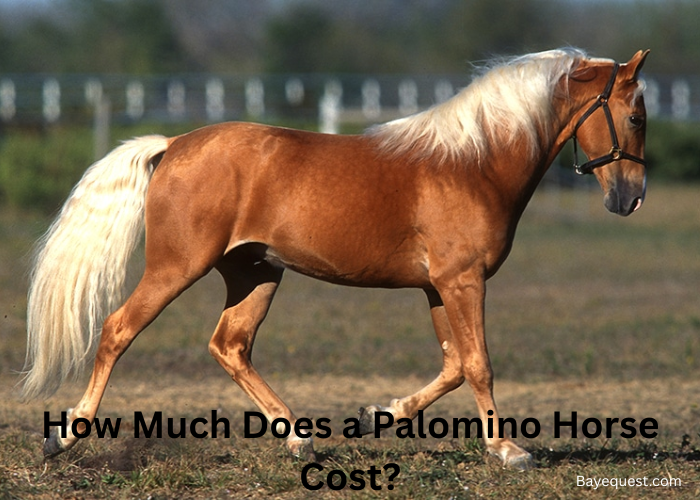
Palomino refers to a unique equine coat color. They are creamy or golden-colored horses with white, silver, or ivory manes, tails, and manes.
White markings on the face and legs are also common. Interestingly, the palomino coat is formed on a red-based skin. It only occurs in horses with a cream gene, which causes a cream or golden coat.
Which Breeds are Palomino Horses?
Nearly any horse breed can have palominos. However, according to the Palomino Horse Breeders Association (PHBA), some breeds are more likely to have palominos than others.
The five breeds with the highest palomino rates are Quarter Horses, Morgans, Arabians, Saddlebreds, and Tennessee Walking Horses.
On the other hand, some breeds rarely have palominos. These include Przewalskis, Haflingers, Lipizzaners, and Friesian horses. PHBA and other registries often reject palominos from these breeds.

History and Origin of Palomino Horses
The history of the palomino horse dates back to the 16th century in Spain. The natives bred palominos for their striking colors and used them exclusively for major events.
Alternatively, the color was reserved for the noble class, royal families, and high-ranking military officials. It was a status symbol.
Spanish missionaries and explorers also found their match in palomino horses. They were elegant companions that quickly won hearts in the new world.
Thus, there were hundreds of palominos in the area when the US acquired present-day California during the Mexican-American War.
Their athleticism and striking looks made them popular very fast. Thus, fast breeds found a path to show rings and racing tracks. Meanwhile, the rest ended up in the homes of the wealthy and powerful.
Unfortunately, early breeders struggled to develop new palominos. Therefore, the numbers dwindled at different historical points, rendering palominos threatened.
That’s how the Palomino Horse Breeders of America (1941) and Palomino Horse Association (1936) were formed. The two associations are tasked with ensuring the palomino’s continuity.
Why Buy a Palomino Horse?
Palominos excel in many equine disciplines. Though they aren’t great farm horses, they are a staple in equine competitions. You should consider one if you have an interest in any of the following;
- A pleasure horse
- A stock horse
- A parade horse
Interestingly, their color has a big impact whenever palominos compete in equine contests. In most cases, the color accounts for at least 25% of the horse’s points.
Besides equine contests, palominos make great saddle and fine-harness horses. You’ll also love them as walking horses.
How Much Does a Palomino Horse Cost?
A palomino horse costs anywhere from under $1,000 to over $ 100,000. It depends on multiple factors, but primarily the breed and shade.
The cheapest palominos are derived from the American Quarter Horse and Tennessee Walking Horse breeds, which are fairly common. A Tennessee walker palomino costs $3,000 on average and can be a great choice for trail riding.
The gaited horses are very comfortable to ride. Meanwhile, Palomino Quarter Horses cost $4,000 on average.
Conversely, Lusitanos, Connemaras, and Akhal Teke palominos are fairly expensive. Lusitanos and Connemara ponies cost between $10,000 and $12,000. But they excel in dressage disciplines.
Also, Connemaras are excellent jumpers. Meanwhile, mature Akhal Tekes cost at least $20,000 and are some of the best endurance and event horses.
Remember that the asking price also depends on the training and show records. Highly trained palominos are more expensive, irrespective of the breed. Similarly, an enviable track record can increase the asking price by a few thousand dollars.
| Cost Category | Details | Cost Range |
|---|---|---|
| Initial Purchase Price | Tennessee Walking Horse | Average $3,000 |
| Quarter Horse | Average $4,000 | |
| Lusitanos & Connemaras | Up to $10,000 – $12,000 | |
| Mature Akhal Teke | At least $20,000 | |
| Boarding Costs | Full-Board Plans | $600 – $2,000/month |
| Self-Care Plans | Starting at $200/month | |
| Partial/Pasture Boarding | Starting at $300/month | |
| Feeding Costs | General | $760 – $3,650/year |
| Supplements | Additional $1,000/year | |
| Veterinary Costs | General Health and Routine Care | $500 – $1,000/year |
| Vaccination, Oral Hygiene, Deworming | $500/year | |
| Equine Insurance | $200 – $400/year | |
| Grooming Costs | General Hoof Care | $300 – $800 |
| Shoeing | $950 – $2,750/year | |
| Training Costs | Basic Training by Pre-Trainers | Around $70/month |
| Advanced Training for Competitions and Events | At least $1,500/month | |
| Other Costs | Equipment (Saddle, Lead Ropes, etc.) | At least $2,000 initially |
| Registration with PHBA (Palomino Horse Breeders of America) | $60 – $80 |
Breaking Down Palomino Horse Prices
After budgeting for the purchase, it’s time to focus on the ownership costs. Consider the following five ownership expenses;
Boarding costs
Horse boarding facilities provide shelter and various other services, taking the burden off your back. You have multiple options. However, most facilities provide full-board, partial-board, and self-care boarding plans.
Full-board plans are the most convenient but also the most expensive. The facility takes full responsibility for the horse, from feeding and grooming to providing medical services. But it costs at least $600/month and as much as $2,000/month at luxury facilities.
Self-care plans are much more affordable, starting at around $200/month. However, the owner is responsible for the horse’s every need, except for housing.
For instance, owners must bring hay and feed the horse. Moreover, you must bring the watering equipment and even the water.
Partial and pasture boarding combine the best of both worlds. The facility provides the basics, including feed and water (on the owner’s bill), at a fraction of the cost of full-care plans. Prices start at $300/month.
Feeding costs
Palomino feeding costs depend on the horse breed, size, and your goals. Generally, western breeds eat more, while hardy breeds like the Arabian are moderate feeders.
Bigger horses often eat up to 50 pounds of hay daily, while smaller ones only need 15-20 pounds.
Finally, special-purpose horses require special and often more expensive diets for optimal performance. i
Nonetheless, depending on local prices, most horses consume $4 to $20 worth of hay and grains daily. This translates to $760 to $3,650 annually. Additionally, set aside $1,000/year for supplements and 6-20 gallons of water daily.
Under or overfeeding your horses can cause serious challenges. It impacts their performance and may cause health issues, shortening the horse’s life.
Veterinary costs
Palominos are susceptible to various health conditions. For instance, allergies are a very common condition.
Dust allergies can cause chronic obstructive pulmonary disease (COPD), leading to serious respiratory conditions. Alternatively, insect bites can cause skin rashes, such as urticaria, necessitating immediate veterinary care.
The horses may also occasionally suffer from colic disease, back issues, or mud fever. To mitigate these issues, you typically need a substantial budget of $500 to $1,000.
Additionally, palomino owners must prepare for routine care, including vaccination, oral hygiene, and deworming. A $500 annual budget is sufficient, but you may need more for racing and show horses, as they require closer attention. Older horses also need greater attention.
Finally, would you like equine insurance? It covers most bills and can be a lifesaver in the long run. If so, set aside $200 to $400 per year for comprehensive coverage.
Grooming costs
Grooming a palomino isn’t very different from grooming regular horses. However, greater attention to detail helps maintain a healthy, shiny coat. Proper care also averts itching and common skin diseases.
So, you must invest in quality grooming brushes, which cost more. A medium-bristled brush is best suited for the job. Never use regular bleach or other chemicals to whiten the manes.
Instead, you need a special whitening shampoo specially designed for palominos. Daily grooming is essential for achieving optimal results.
Besides cleaning, you must budget for farrier services, specifically hoof care and shoeing. A budget of $300-$800 is sufficient for general hoof care. Meanwhile, shoeing costs $950 to $2,750 per year.
Training costs
Many owners overlook training costs when buying a horse, a catastrophic mistake, because training is the largest expense in horse ownership. Indeed, training costs often exceed the purchase price during the ownership period.
Pre-trainers charge around $70/month for a few hours of training every week. But they cover the bare basics to keep the horse fit and cooperative. You will need to invest significantly more for additional training.
For instance, you may enjoy horse jumping and trotting sessions with friends and family without signing up for events. If so, a semi-pro can train the horse for $400, possibly over a period of 2-3 months.
Meanwhile, it costs at least $1,500 per month, year-round, to prepare the horse for competitions and events. That’s $18,000+/year.
Other costs
Horse owners must also budget for a few more things. For example, do you have the equipment, from the saddle to lead ropes?
It costs at least $2,000 to get the entire tack if it’s your first horse. But feel free to reuse old equipment if you’re a veteran. Alternatively, consider second-hand items from eBay.
Additionally, every Palomino owner takes pride in registered stock. What’s the point of buying one if you can’t show off?
Unfortunately, registration isn’t free. For example, PHBA charges $60 to register a new foal and $80 for palominos aged two years or more.
Palomino Horse Characteristics
It’s easy to confuse palominos with other horse colors. So, you should look out for the defining characteristics. These include;
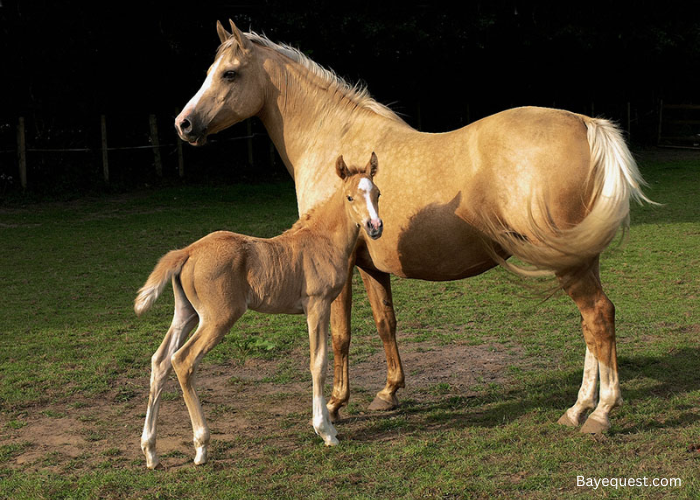
- Chestnut and cream dilution genes: Every true palomino has a special gene that consists of a chestnut base and a cream dilution gene. A DNA test (if requested) must reveal both genes. Otherwise, it’s not a true palomino.
- A creamy, golden coat: Without a DNA test, the creamy, yellow, or golden coat is the most prominent characteristic of a palomino. However, champagne and Cremello horses are not palominos.
- Dark skin underneath: Always check underneath the coat to verify the skin color. All palominos have dark, typically gray or black skin. Contrastingly, champagne and Cremello horses have pink skin.
- A flaxen tail and mane: The major palomino registries are very specific about the manes and tails. The flaxen tails and manes must be at least 75% white and up to 25% brown, gray, or black.
Shades of the Palomino
Though the golden coat with a bright yellow hue is the standard palomino color, registries accept a few variations, including;
- Light palomino: These are the lightest of palominos. You may even confuse it with white. However, a closer look reveals a soft, cream-colored coat with a yellow hue.
- Light palomino: This is still a light, sandy-colored coat. But the yellow hue is more noticeable. The manes and tails are often white.
- Golden palominos: These are rich golden horses with a coin-like coat. The shiny coats catch the sun’s reflection. Meanwhile, the tail and mane are white.
- Chocolate palominos: Chocolate palominos are dark brown, often with white manes and tails. You may spot a few black or brown hairs on the tail or mane.
- Pearl palominos: Pearls have a lustrous sheen on a light cream coat. A few, especially among Andalusian and Lusitano breeds, have green or blue eyes.
- Champagne palominos: These horses possess the champagne gene, causing a gold-chestnut coat.
FAQs
How rare are Palomino horses?
Palomino horses are fairly common, as they refer to a color mutation rather than a distinct horse breed. Moreover, any two horses can sire a palomino, no matter the breed, as long as one of them has palomino genetics. That said, palominos are very rare among some horse breeds.
How long does a Palomino horse live?
Palominos live for 20-25 years, depending on the specific breed and the horse’s quality of care. Icelandic palominos have the longest lifespans. They live well into their thirties and easily reach 40 years. Meanwhile, wild mustang palominos have the shortest lifespans, rarely exceeding 18 years.
How do you get a Palomino horse?
Breeders keen on producing a palomino color must have the base color of red and a copy of the cream color from each parent. But note that red is a recessive gene in horses. So, the parents don’t have to be red as long as they recessively carry the genes. Crossing the parents produces a palomino foal.
Is a Palomino a good horse?
Yes, palomino horses are highly desirable. They stand out in the show ring and are highly sought-after parade horses. Moreover, the palomino color was associated with wealth and royalty in ancient times. Nonetheless, the level of desirability depends on the breed. Palomino Arabian horses are some of the most desirable equines.
Related read: How much does a Paso Fino horse breed cost?
Conclusion
When you’re looking to buy a Palomino horse, the price tag can swing a lot. It’s not just about how pretty they are or their age.
Factors such as their family tree, level of training, and health also play significant roles. If you dream of owning one, whether for shows or just as a buddy, remember that Palominos are special. However, don’t just consider the upfront cost.
Owning a horse means taking care of them day in, day out. Knowing all this helps you make better decisions. After all, a Palomino is more than its looks. It’s about the happiness and friendship it brings into your life.