

Did you know that horses are measured not in feet or meters but in ‘hands’? Whether you’re a seasoned equestrian or a curious newbie, knowing how to measure a horse’s height accurately is essential.
This article leverages years of equine expertise to simplify the process, ensuring precise and professional measurements. From identifying the correct tools to understanding the ‘hands’ system, we’ll guide you through each step.
Let’s get started on making your horse measurements a breeze.
How to Measure a Horse’s Height – Key Takeaway
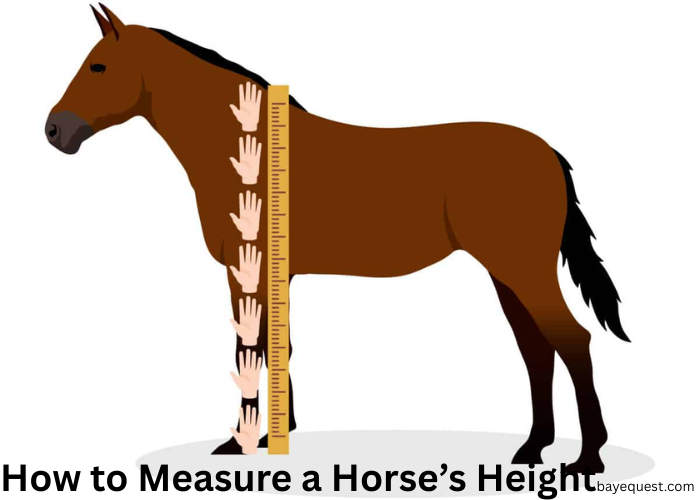
To measure a horse’s height, use a measuring stick or tape to measure from the ground to the highest point of the withers, the ridge between the shoulder blades. This ensures an accurate height in ‘hands,’ the standard unit. Knowing this method helps in understanding a horse’s true height and health.
How Tall is the Average Horse in Hands?
The average horse stands between 15 and 16 hands tall, translating to about 5 and 5.5 feet at the shoulder. However, height varies by breed. Ponies, for example, are under 14.2 hands, while draft horses can exceed 17 hands.
This range helps to categorize horses for different roles, from riding to heavy labor. Knowing the average height helps in selecting the right horse for your needs, whether for riding, showing, or work.
Understanding these differences in height can give you a clearer idea of what to expect when you’re around different breeds of horses.
Why are Horses Measured in Hands?
Horses are measured in hands because it’s a simple, old method that’s still useful today. A ‘hand’ is four inches, roughly the width of a human hand.
This system started when rulers and tape measures weren’t available. People used what they had: their hands.
Measuring in hands remains convenient and helps everyone easily understand a horse’s height. It’s consistent and traditional, so it’s used worldwide.
This method allows for quick comparisons between horses. Whether you’re at a stable or a horse show, saying a horse is ’16 hands’ is clear and universally understood. It keeps things straightforward.
How to Measure a Horse by Hands
One hand is equal to four inches. When measuring horses in hands, decimals are used for partial measurements. For example, a horse that is 14.2 hands is 14 hands plus 2 inches, which equals 58 inches in total: (14 x 4) + 2 inches.
A horse can’t be 14.5 hands, because the number after the decimal represents whole inches, not fractions. If a horse is 14.2 1/2 HH, it means he is two and a half inches over 14 hands.
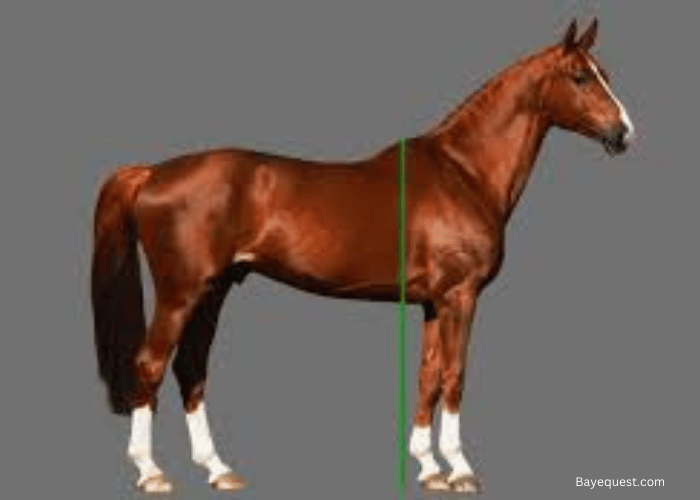
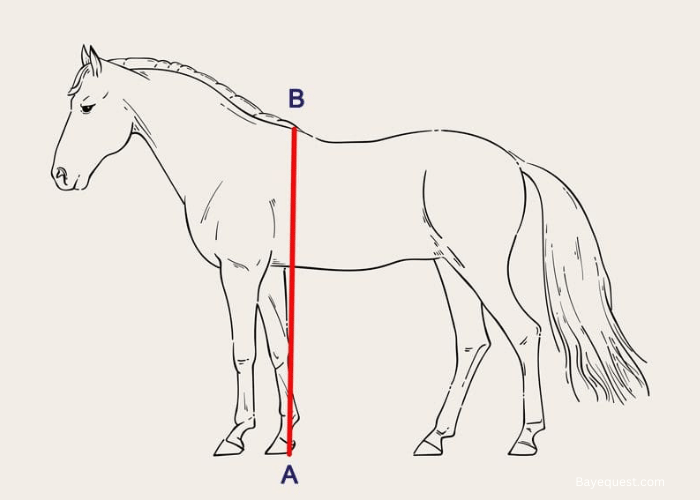
Horses are measured from the ground, just beside and behind a foreleg, to the top of the withers (shoulders).
The withers are a part of the horse that doesn’t change height when the horse moves its head or back. This is the standard method for measuring a horse’s height.
This method is used no matter what measurement unit you use (hands or centimetres), what country you’re in, what type of riding you do, or what breed of horse or pony you have.
Tools for Measuring a Horse’s Height
To measure a horse’s height, you can use several tools:
Equine height measuring stick
This is the most accurate and easiest method. It’s a tall stick with inch measurements and a horizontal bar that slides up and down.
You place the stick beside the horse and slide the bar down to touch the horse’s withers. Some sticks have a leveling bubble to ensure it’s held level.
Height tapes
These can be bought at feed or tack stores. They’re inexpensive but can be tricky to use because they’re light and floppy.
You need one person to hold the bottom against the ground and another to read the measurement at the horse’s withers. The tape must stay perpendicular to the ground.
Often, these tapes also have a horse weight measure on the other side.
Regular tape measure
You can use a regular tape measure, but it has the same issues as height tapes. Metal tape measures can also make noise, which may cause the horse to move.
Homemade measuring device
A simple method is to tie a piece of binder twine to a large metal nut or washer. The weight keeps the string steady while you eye up the withers and mark the twine.
Then measure the length from the bottom of the washer to the mark on the twine. To make it easier, you can use a yardstick, a piece of lath, or even a whip to get a line from the twine to the withers.
Hold the yardstick so it sits on the horse’s withers, parallel to the ground, and note where it hits the tape.
How to Measure a Horse’s Height: Step-by-Step Guide
Step 1: Prepare the Horse
Stand your horse squarely on a flat, even surface. Make sure it’s relaxed and standing naturally—not shifting weight or leaning. This ensures an accurate height reading.
Step 2: Position the Measuring Tool
Place the measuring tape or stick beside the horse. It should be straight, standing upright, and aligned with the highest point of the withers.
Step 3: Use the Measuring Bar
If you have a stick with a sliding bar, lower the bar gently until it rests on top of the withers. Avoid pressing too hard, as this can alter the reading.
Step 4: Record the Measurement
Note the height in inches or centimeters. For horses measured in hands, divide the inches by four. The remainder becomes the decimal. Example: 62 inches equals 15.2 hands.
Step 5: Consider Shoes for Accuracy
For official measurements or competitions, check whether the horse should be barefoot or shod. Shoes can slightly increase height and may affect classification between ponies and horses.
Horse Height Hands Conversion Chart
To help you better understand how hands convert to our traditional units of measurement, I’ve put together a handy conversion chart.
| Hands | Inches | Feet | Meters |
| 12.0 | 48 | 4ft 0in | 1.2192 |
| 12.1 | 49 | 4ft 1in | 1.2446 |
| 12.2 | 50 | 4ft 2in | 1.27 |
| 12.3 | 51 | 4ft 3in | 1.2954 |
| 13.0 | 52 | 4ft 4in | 1.3208 |
| 13.1 | 53 | 4ft 5in | 1.3462 |
| 13.2 | 54 | 4ft 6in | 1.371 |
| 13.3 | 55 | 4ft 7in | 1.397 |
| 14.0 | 56 | 4ft 8in | 1.4224 |
| 14.1 | 57 | 4ft 9in | 1.4478 |
| 14.2 | 58 | 4ft 10in | 1.4732 |
| 14.3 | 59 | 4ft 11in | 1.4986 |
| 15.0 | 60 | 5ft 0in | 1.524 |
| 15.1 | 61 | 5ft 1in | 1.5494 |
| 15.2 | 62 | 5ft 2in | 1.5748 |
| 15.3 | 63 | 5ft 3in | 1.6002 |
| 16.0 | 64 | 5ft 4in | 1.6256 |
| 16.1 | 65 | 5ft 5in | 1.651 |
| 16.2 | 66 | 5ft 6in | 1.6764 |
| 16.3 | 67 | 5ft 7in | 1.7018 |
| 17.0 | 68 | 5ft 8in | 1.7272 |
| 17.1 | 69 | 5ft 9in | 1.7526 |
| 17.2 | 70 | 5ft 10in | 1.778 |
| 17.3 | 71 | 5ft 11in | 1.803 |
| 18.0 | 72 | 6ft 0in | 1.8288 |
Common Horse Measuring Mistakes
Measuring a horse sounds simple. In reality, small mistakes can change the result by an inch or more.
Here are the most common errors to watch out for.
Not standing on level ground. Uneven surfaces shift the horse’s posture and throw off the reading. Always measure on flat, firm ground for consistent results.
Restless or improperly standing horse. If the horse is leaning, bending a leg, or holding its head too high or low, the height will be wrong. The horse should stand square with weight evenly distributed.
Using rigid tools for body measurements. Yardsticks and metal tapes work for height but fail when measuring girth or blanket size. A flexible tailor’s tape follows the horse’s natural shape and gives accurate body measurements.
Measuring alone. Trying to measure on your own often leads to crooked tools and shaky readings. Having a helper keeps the tape steady and the horse calm.
Measuring from the wrong place. Height must be measured at the highest point of the withers, not the head, neck, or middle of the back. The withers stay consistent even when the horse moves.
Ignoring the shoe allowance. Shoes can add extra height. For official measurements, some organizations require subtracting about ¼ to ⅜ of an inch if the horse is shod. Always check the rules.
Miscalculating “hands”. One hand equals four inches. The number after the decimal represents inches, not fractions. For example, 62 inches is written as 15.2 hands, not 15.5. Likewise, 63 inches becomes 15.3 hands, not 15.75.
How to Measure the Height of a Horse: FAQs
When do horses reach their full height?
Most horse breeds reach their full height when they are about four or five years old. After that, they might get a bit wider or fill out for another 2 to 3 years. Draft horses and mixed breeds may continue to grow until they are eight years old.
How can you predict a horse’s height when they’re young?
There’s no way to know for sure how tall a horse will be when it’s fully grown, but there are some clues. Most of a horse’s growth happens in the first year. By 12 months old, horses have reached about 90 percent of their full height. So, how tall your horse is at 12 months old can give you a good idea if they’ll be short or tall.
Related read: When Do Horses Stop Growing?
What height horse should I ride?
Height isn’t a big deal when choosing a horse. If you’re shorter but feel good on a taller horse, that’s okay. But tall horses can be hard to get on without a mounting block. When picking a horse, it’s more important to think about how much weight the horse can carry comfortably.
How tall is 14 hands on a horse?
A horse that is 14 hands tall measures 56 inches or 142.24 centimeters in height. The term “hand” is a traditional unit of measurement in equestrian contexts, with one hand equaling 4 inches (10.16 centimeters). This measurement is taken from the ground to the horse’s withers, the highest point of its back at the base of the neck.
Horse Height Measurement: Conclusion
Measuring a horse correctly makes a real difference. It helps with proper fit, feeding plans, and choosing the right work or discipline.
Measure straight from the ground to the withers using a ruler or tape. Keep the horse standing level and still. Do it right, and you’ll always know your horse’s true height.
What next? Check out our article on Jockey Weight and Height to learn how a jockey’s size complements the horse’s build for peak performance.