

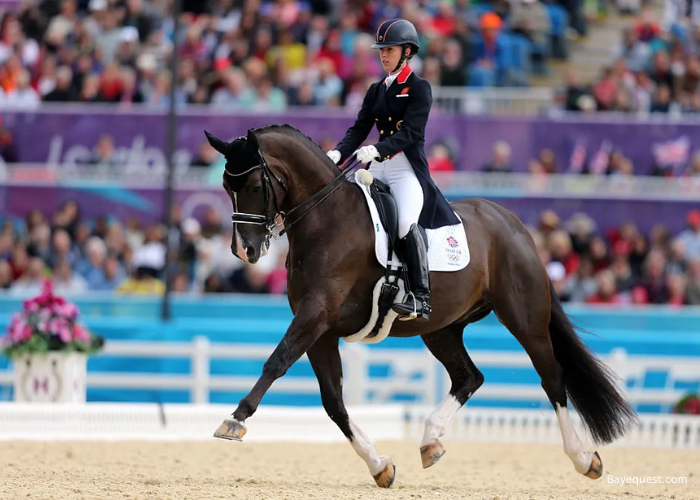
Dressage is one of the oldest forms of competitive horse riding, with roots stretching back centuries. Today, it is seen at everything from local horse shows to the Olympic Games. But what does dressage mean in horse riding, and what makes it different from other equestrian sports?
Read on to discover where dressage came from, how it works, what happens during a test, how judges award scores, and the welfare concerns surrounding the sport.
What Actually Happens in a Dressage Test
The horse trotting on the spot is not a party trick. It is close to the hardest thing in the ring.
A dressage test is a published, fixed sequence of movements. Every competitor at that level rides the identical routine, from memory, in the same rectangle.
Execution is the only variable.
Riders enter at A, halt and salute the judge at the centre point, ride the sequence, then halt and salute again.
On screen you are seeing:
-
Piaffe: trotting on the spot, barely travelling forward.
-
Passage: a slow, lifted, floating trot with visible hang time between steps.
-
Pirouette: the horse keeps cantering while turning a full circle around its hind legs.
-
Half-pass: the horse travels diagonally sideways and forwards at once, bent toward the direction of travel.
-
Extended trot: same rhythm, dramatically longer strides.
-
Flying change: the horse swaps its leading front leg mid-canter, in the air. At Grand Prix, riders do one every stride down the diagonal.
A horse’s instinct under a rider is to move forward to escape pressure. Piaffe asks for the energy of a powerful trot with almost none of the travel.
Maximum push, minimum ground covered. That contradiction is the difficulty.
There is also an invisibility rule. The rider’s cues, called aids, should be almost impossible to spot.
See the rider working, with an obvious leg or repeated corrections, and the score drops. Judges ask whether a correction was subtle or took loud, repeated effort.
So “the rider is just sitting there” is not boring. It is the skill.
One fault you can hear. A horse that is forging makes an audible click as a hind foot strikes a front foot, telling the judge the shoulders are not lifting out of the hind legs’ way.
Why These Movements Exist: From Xenophon to the Spanish Riding School
You have probably been told these movements were designed for the battlefield. Mostly, they were not.
Xenophon, a Greek cavalry officer and a student of Socrates, wrote On Horsemanship around 400 BC. It is one of the oldest surviving texts on humane horse training, and the root of classical dressage.
This is a 2,400-year-old tradition, not a modern showpiece.
The names came much later. The airs above the ground and the school movements (piaffe, passage, pirouette, levade, capriole, courbette) take their names and much of their development from Italian Renaissance riding masters.
Piaffe is the clearest example. The word is thought to come from the Italian a piede fermo, roughly “with still feet,” which is exactly what trotting on the spot looks like.
French students who trained in Naples compressed it to “pie-fer,” then “piaffer.”
So where does the war story fall down? Historians point to a mechanical problem: in their modern form, nearly all of these movements expose the horse’s underbelly to a foot soldier’s blade.
Terrible idea in a fight. Far more likely, they were off-battlefield training and conditioning exercises.
The main exception is the capriole, a leap with a mid-air kick out behind. That one genuinely could drive off attackers on foot.
The popular version is half right. The half that is wrong is the half everyone repeats.
The lineage never broke. The Spanish Riding School in Vienna has trained Lipizzaners in this tradition for more than 450 years and still performs the movements.
The modern sport formalized it into scored tests. Dressage has been in the Olympic Games since 1912.
The Dressage Arena: Two Sizes and What the Letters Mean
The letters are the first thing anyone notices and the last thing anyone explains.
A dressage arena comes in two sizes. The small arena is 20 metres by 40 metres and covers most national levels.
The standard arena is 20 by 60 metres, required from roughly Prix St Georges, the first international class, upward.
Learn three letters and the rest is decoration.
A sits at the middle of one short end. That is the entrance.
C sits directly opposite at the far short end, where the head judge sits. X is dead centre of the rectangle, where the halt and salute happens.
Now walk the small arena. From A you pass K, E and H down one long side, reach C at the far end, then return past M, B and F to A.
Three letters sit on the centre line joining A to C: D near A, X in the middle, G near C.
Riders remember them as “All King Edward’s Horses Can Manage Big Fences.”
The large arena adds four letters outside and two on the centre line. Going the same way from A, the outside reads K, V, E, S, H, then C, then M, R, B, P, F.
The centre line reads D, L, X, I, G.
Small arena letters sit 14 metres apart on each long side, with A and C 10 metres from the corners of the short ends. Large arena letters sit 12 metres apart, five to a side.
Why these letters? Nobody actually knows.
One story says grooms at a German royal stable waited beside a letter standing for their master’s title: K for Kaiser or König, F for Fürst, R for Ritter.
Treat it as folklore. It cannot explain D, L, X, I and G at all.
The letters have a job. Accuracy is scored: a movement must start and finish at a named marker, and missing it costs points even when the movement felt good.
How Dressage Is Scored: What Separates a 6 From an 8
Two rides can look identical to a newcomer and finish four percentage points apart. Dressage scoring has a formula behind the gap.
FEI judge Janet Foy teaches the sequence like this:
-
Start with the raw quality of the gait, the horse’s natural way of moving, ignoring the rider. Is this a 7-trot or an 8-trot?
-
Adjust for accuracy. Did the horse hit the marker, hold the line, and complete the required shape?
-
Adjust for straightness and rhythm. Back end behind the front end, tempo steady, no rushing.
-
Adjust for the rider. Subtle aid, or visible repeated effort?
-
Score 0 to 10, half points allowed, then apply coefficients.
A 0 means not performed, a 10 means excellent. A run of 6s and 7s is solid, correct work for the level.
A 4 or 5 flags a clear fault: lost rhythm, wrong lead, missed movement. An 8 or 9 needs expression and ease well past correctness.
A 10 is not a “wow” reaction. It is the moment the judge, thinking as a trainer, cannot name one thing that would make it better.
The gaps are tiny in practice.
Foy gives a canter transition 7.5 because the rider needed to “be a little bit steadier in the contact.” She gives a walk transition a 10 for being “really good, really soft.”
There is no softer standard for children, ponies or adult amateurs. Foy: “we don’t have a different standard for kids… it’s the same.”
That is why beginner scores look brutal.
The judge is measuring the training scale, six elements built in order: rhythm, suppleness, contact, impulsion, straightness, collection.
Rhythm: Correct footfall sequence, regular tempo.
Suppleness: Elastic, free of tension.
Contact: Calm acceptance of the bit (the mouthpiece), never forced.
Impulsion: Forward energy from the back legs.
Straightness: Back end directly behind the front end.
Collection: Back legs carrying more weight, better balance, lighter front end. Collection is only real if everything beneath it is in place. A horse forced into a collected shape without rhythm and suppleness underneath is faking the top of the scale.
Then come the multipliers. Some movements, and all five Collective Marks given at the end of a test, carry a coefficient of 2, so those scores double.
Every score is added and converted into a percentage of the maximum. That percentage, not the point total, is the result.
With several judges scoring from different positions, the final figure averages their individual percentages.
This is why riders argue with score sheets. A movement that felt perfect still scores a 6, usually on accuracy the rider could not feel.
Dressage Levels Explained: The US and UK Ladders Side by Side
Look up dressage levels twice, and you get two different answers. Neither source is wrong. There are genuinely two ladders.
Below international level, there is no global system. Each country runs its own, and all feed into the same FEI levels at the top.
Neither federation acknowledges the other exists, which is why competitors still argue about it on Horse & Hound forums.
The American ladder runs Introductory, Training, First, Second, Third, Fourth. The British runs Introductory, Preliminary, Novice, Elementary, Medium, Advanced Medium, Advanced.
Put simply: what the Americans call Training, the British call Preliminary. US Third sits near BD Advanced Medium but is easier, with only one flying change each way, no canter entry and no 8 metre circles.
Above that, both share the FEI ladder: Prix St Georges, Intermediate I, Intermediate II and Grand Prix. Grand Prix is the Olympic level.
These are approximate equivalences, not official conversions. British Novice has a harder counter-canter line (cantering on the “wrong” leg) than US First.
The American “stretchy-chewy circle,” where the rider lets out the reins and the horse stretches its neck down, appears in the low US tests but not the British ones.
Now the percentage confusion. You will see 60% in one article and 65% in another. Both are correct, because they answer different questions.
-
60% in British Dressage: the minimum score at Prelim or above in an affiliated class that earns points toward level eligibility.
-
65%: the informal rule of thumb that a horse and rider are ready to move up a level.
-
60% at USDF: a qualifying score for the rider medal program, with a “Distinguished” tier added in 2022 needing roughly 67%.
A percentage means nothing until you know which system produced it and which question it answers.
Freestyle to Music: How the Kur Is Judged
The dressage clip that went viral was probably a Freestyle, a separate event with its own scoring system.
A normal dressage test is a fixed, published sequence every competitor rides identically. In the Freestyle, known as the Kur, the rider choreographs their own routine to their own music within a required set of movements.
This is the highlight-reel event, and it runs on two scoring tracks. Technical marks are scored 0 to 10 per movement, exactly as in a normal test.
Artistic Impression marks are also scored 0 to 10, across five areas: rhythm, energy and elasticity; harmony; choreography; degree of difficulty; and music and interpretation.
Those artistic marks carry a coefficient of 4. A 7 for choreography contributes 28 points once the multiplier lands.
The most spectator-friendly event is also the hardest to score. The music is not decoration either, because riding in time with the beat is the scored skill.
Judges assess how well the horse’s footfall rhythm fits the beat, plus the logic and symmetry of the choreography.
Watch whether the feet land on the beat, and whether the routine repeats its patterns evenly in both directions. When the music is chosen well, the horse looks like it is setting the tempo rather than chasing it.
Is Dressage Cruel? The Welfare Controversy, Honestly
You have probably seen a headline about abuse in dressage with no way to judge how bad it is. Here are dates and rules.
It can be cruel. Force-based training does harm, so does excessive whipping, and the FEI, the sport’s governing body, has disciplined riders for both.
Rollkur and hyperflexion
“Low, Deep and Round” is a horse stretched forward, down and round without force, which the FEI accepted. Rollkur, or hyperflexion, is the same head and neck position forced through sustained mechanical pressure, which it called abusive.
The 2025 rules revision dropped that distinction rather than police the line. Critics say it leaves the rule murkier for outsiders.
The Dujardin case
Charlotte Dujardin is a three-time Olympic dressage gold medallist. She withdrew from the Paris 2024 Olympics days before her event, after a video surfaced of her repeatedly whipping a horse’s legs in a session filmed four years earlier.
The FEI provisionally suspended her, then in December 2024 issued a one-year ban and a 10,000 Swiss franc fine, roughly GBP 8,886.
Backdated to the July 2024 suspension, it let her return from July 2025, and she resumed domestic competition around December 2025.
Elite status did not exempt her. The person who leaked the footage called it an attempt to save dressage, not destroy it.
The January 2026 Amsterdam criticism
In January 2026, the welfare organization Collectif Pour Les Chevaux published an eight-minute video analyzing Dujardin’s warm-up on the mare Alive and Kicking at Jumping Amsterdam on 24 January. Its founder is veterinarian Eva Van Avermaet.
The group edited the footage with slow motion and commentary at a Times sports reporter’s request, and it passed 100,000 views.
Van Avermaet says she told a steward that, in her opinion, Dujardin’s rein use was too rough.
That is a welfare organization’s public criticism and a complaint raised with a steward. It is not a disciplinary finding, a sanction, or a proven rule breach, and no FEI sanction resulted.
What has actually changed
The FEI standardized noseband tightness across all disciplines on 1 May 2025, pushed back from a proposed 1 January 2025 so stewards could be trained.
A noseband is the strap around a horse’s nose. Stewards check it with the official FEI Measuring Device, a pass-through tool 1.7 cm thick (about 0.7 inches), slid under the noseband over the nasal bone and drawn top to bottom.
It covers every noseband type, upper and lower. Fail, and you cannot start.
Plenty is unsettled. In May 2024, the FEI opened disciplinary proceedings against elite rider Cesar Parra, with hyperflexion among the allegations.
During the 2026 rules revision, Poland lobbied to add hyperflexion to the FEI’s prohibited-practices list. The FEI declined, pending further assessment.
The sport has made real rule changes and sanctioned its biggest star. It has also declined to ban the practice its critics care most about.
Dressage Is Not Only English: Western, Cowboy and Para Dressage
Dressage does not require an English saddle. There is a full Western version, with its own USEF-recognised rulebook.
The Western Dressage Association of America was founded in 2010 and built a formal test structure. It partnered with USEF to produce an official rulebook, which established it as a USEF-recognised discipline.
The American Quarter Horse Association recognized it as points-eligible in 2020.
It runs on five training principles: straightness, control of the front end, control of the hind end, collection, and canter departures (moving up into canter cleanly).
Riders use Western tack, meaning a Western saddle and bridle, and the gaits are called walk, jog, and lope rather than walk, trot, and canter.
For a rider already comfortable in a Western saddle, that is an on-ramp rather than a change of discipline.
Cowboy Dressage is a different thing. It is a separate, trademarked training brand rather than a sanctioning body’s discipline, created by trainer Eitan Beth-Halachmy and his wife Debbie.
Its guiding principle is “Soft Feel,” a wordless, close communication between horse and rider. The two terms were used interchangeably until WDAA formalised its own rulebook.
Para-dressage widens the door further, with five grades scaled to a rider’s functional ability rather than excluding riders with impairments.
Grade I covers the most severe impairment, and those tests are ridden in walk only. Grades II and III ride walk and trot.
Grades IV and V add canter and lateral (sideways) work, with Grade V the mildest impairment.
Grade Ib riders typically use a wheelchair in daily life, while a Grade V rider may have a single mild limb deficiency or partial sight loss.
Para equestrian first appeared at the Paralympic Games in 1996 in Atlanta, giving it nearly thirty years of infrastructure.
What It Actually Costs to Start Dressage
A new dressage saddle runs USD 3,000 to 8,000. A licensed US show often costs USD 150 to 250 or more once fees are added.
You do not start by buying anything. Take lessons with a qualified dressage instructor first, and learn position and aids on a lesson-program horse.
The introductory and training levels suit a green (barely trained) or moderately schooled horse.
Federation membership runs USD 100 to 500 a year, and a horse’s one-time USDF registration costs USD 95.
Typical figure: Dressage saddle, new USD 3,000 to 8,000
Federation membership per year USD 100 to 500; USDF one-time horse registration: USD 95. Licensed show, all fees: USD 150 to 250 or more
The saddle is the easiest to defer or buy secondhand.
The entry price is never the real price.
A licensed US show stacks separate charges per horse and rider: an office fee around USD 50, a USEF fee around USD 25, and a USDF non-member fee around USD 55. Add a regional qualifying fee around USD 40 plus about USD 10 per class.
Skipping membership costs extra, not less. Non-members of USEF pay an added USD 45 per show, and non-members of USDF or a regional Group Member Organization an added USD 35.
Start at schooling shows instead: unrecognised, cheaper, and the standard entry point.
Then there is the horse. Unstarted warmblood prospects (the European sport-horse breeds) aged three to five commonly list around EUR 15,000 to 20,000, and a competitive mid-career mare can list at EUR 70,000 to 100,000.
Older, fully trained schoolmasters, which can teach a rider through Grand Prix movements, sell at a premium because they forgive rider mistakes.
Learning to ride dressage is priced like a serious hobby. Competing at the top is priced like motorsport.
What Does Dressage Mean in Horse Riding? FAQs
Do you need a special breed of horse to do dressage?
No at national levels, and effectively yes at the very top. Warmbloods dominate elite dressage, including the Dutch KWPN and the German Hanoverian and Oldenburg, bred for an uphill build, elastic gaits and trainable temperament. That dominance makes the sport look breed-gatekept, but lower levels are open to any well-trained horse.
Is dressage an Olympic sport, and is there a Paralympic version?
Yes to both. Dressage has been part of the Olympic Games since 1912, and the Olympic level is Grand Prix, the top of the international FEI ladder. Para equestrian first appeared at the Paralympic Games in 1996 in Atlanta, and now runs five grades scaled to each rider’s functional ability.
What is a piaffe?
A piaffe is a trot performed almost entirely on the spot, with the horse’s energy contained rather than released forward. The name is thought to come from the Italian a piede fermo, roughly “with still feet,” which French students compressed into “piaffer.” It demands full trot power with almost no forward travel.
What are the collective marks on a dressage score sheet?
Collective marks are five overall judgments given at the end of a test, not for any single movement: Gaits, Impulsion, Submission, Rider’s Seat and Position, and Rider’s Use of Aids. Each typically carries a coefficient of 2, so one collective mark weighs about as much as two ordinary movements.
How do you become a dressage judge?
It takes roughly a decade. Candidates start with the apprentice “L program,” then work through years of training and apprentice exams up to senior and international levels. Judges learn to read “visual indicators,” meaning muscular tells on a horse’s body showing whether a movement is produced correctly or through compensation.
How is dressage different from other horse riding disciplines?
Dressage scores how the horse moves, while most other disciplines score whether a task was completed. There are no fences, no clock and no cattle. It is also the training foundation other disciplines borrow from, which is why show jumpers and eventers do dressage work even when they never compete in it.
What Does Dressage Mean in Horse Riding? Conclusion
Dressage goes far beyond memorizing movements and earning a score. Its history, training principles, judging system, and different disciplines reveal how much goes into every test.
Whether you want to ride or simply understand the sport, knowing these basics makes dressage much easier to follow and appreciate.