


Getting the right blanket starts with one thing. The measurement.
A blanket that fits poorly causes rubbing, restricts movement, and can shift dangerously. A few minutes with a tape measure saves a lot of problems later.
Here’s exactly how to do it.
How to Measure a Horse for a Blanket: Key Takeaway
- Measure from the center of the chest to the base of the tail
- Always use a soft, flexible tape measure
- Keep the tape level and taut, not pressed into the body
- If your horse falls between sizes, always size up
- Most blankets are sized in 3-inch increments
- Build matters more than height
Why the Right Fit Matters
A poorly fitted blanket is more than uncomfortable. It can become a genuine welfare issue.
A blanket that is too tight pulls across the shoulders, restricts movement, and causes painful rubs. One that is too loose can shift, twist, or tangle around the legs.
A well-fitting blanket keeps your horse warm, comfortable, and able to move naturally. The good news is that measuring is quick and easy when you use the right technique.
What You Need Before You Start
You don’t need much for this. But what you do need matters.
Start with a soft, flexible tape measure. A rigid one won’t follow your horse’s body correctly. No measuring tape? A piece of string or baling twine works fine. Just mark your measurement, then lay it flat alongside a standard ruler or tape measure afterward.
A helper isn’t strictly necessary, but it makes the job easier and more accurate. One person holds the tape at the chest while the other guides it to the tail.
Level ground matters too. Your horse needs to stand squarely on a flat, even surface, since any slope will skew the measurement. Make sure all four feet are evenly placed before you start.
Last thing: bring a pen and paper. Write the number down immediately. Don’t rely on memory.
How to Measure a Horse for a Blanket: Step by Step
This is the core measurement. Everything else follows from it.
Step 1: Position Your Horse
Stand your horse on flat, level ground. Make sure they are standing square. All four hooves should be evenly placed.
A relaxed horse gives a more accurate measurement. If your horse is tense or shifting, the number will be off.
Step 2: Find the Starting Point
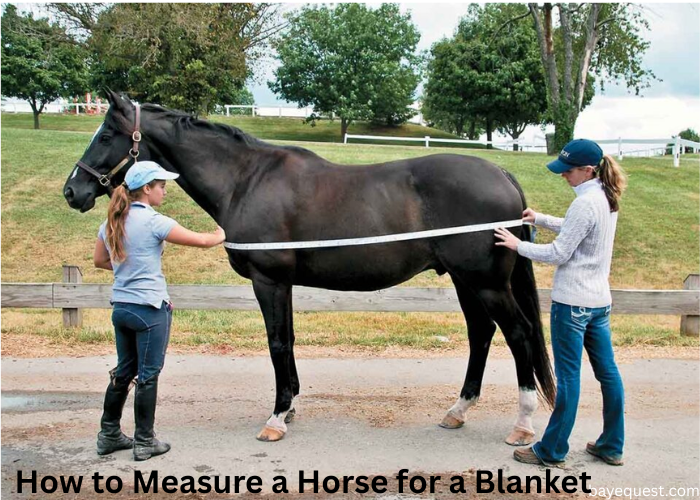
Stand at your horse’s shoulder and locate the center of the chest, just above where the front legs meet. This is your starting point.
Do not start from the top of the withers. Do not start from the side of the chest. The center point of the chest is the correct and consistent starting point.
Place the end of your tape measure here. Hold it firmly in place.
Step 3: Run the Tape Along the Body
Run the tape along your horse’s side, over the widest part of the shoulder and barrel. Keep it level and smooth against the coat.
The tape should be taut, but not tight. Do not let it sag, and do not press it into the body.
This line should follow the way a blanket sits on the horse. Measuring diagonally or pulling too tightly can give you the wrong size.
Step 4: Stop at the Base of the Tail
The measurement ends once you have reached the point of the buttocks, where the cheek meets the tail.
Stop at the base of the tail, where the tail begins to grow from the body. Do not measure to the middle or end of the tail.
Write down the number. This is the measurement you will compare with the blanket size chart.
Step 5: Round Up if Needed
If your horse’s measurement falls between sizes, round up to the next size for a comfortable fit.
Most blankets are sized in 3-inch increments — 72″, 75″, 78″, 81″, and so on. If your horse measures 71 and your choices are 69 or 72, choose 72. It’s better to be a bit loose than a bit tight.
Horse Blanket Size Chart
Use this general chart as a starting guide. Always verify with your own measurement.
| Horse Height | Approximate Blanket Size |
| 14.0 – 14.2 hands | 68″ – 72″ |
| 14.2 – 15.0 hands | 72″ – 75″ |
| 15.0 – 15.2 hands | 75″ – 78″ |
| 15.2 – 16.0 hands | 78″ – 81″ |
| 16.0 – 16.2 hands | 81″ – 84″ |
| 16.2 hands and above | 84″ – 90″ |
These are guidelines only. Build matters more than height. A stocky horse may need a larger size than the height chart suggests, while a narrow-built horse might need a smaller size.
Common Measuring Mistakes to Avoid
Even experienced horse owners get this wrong sometimes. Here’s what to watch for.
Starting from the wrong point throws everything off. Always begin at the center of the chest. Too high or too low skews the entire measurement.
Pulling the tape too tight is another common mistake. The tape should sit snug but never press against the body. Pressing into the contours adds false inches, and you’ll end up with a blanket that’s too large.
Measuring diagonally causes problems too. The tape needs to follow the natural curve of the barrel. A diagonal line from chest to tail gives you an inaccurate result every time.
When you’re between sizes, always round up. A slightly generous fit beats one that pulls across the shoulders.
Uneven ground changes everything. Even a slight slope alters how your horse stands, so stick to flat, level ground.
And don’t measure alone if your horse is fidgety. A horse that moves mid-measurement gives you a wrong number. Grab a helper if your horse tends to be restless.
Interesting read: How to Wash Horse Blankets in 3 Ways.
How to Check the Fit Once the Blanket Arrives
Measuring correctly is the first step. Checking the fit properly is just as important.
The chest
The front closure should allow for natural movement without gaping or pulling. Use the two-finger rule: you should be able to slip two fingers between the blanket and your horse’s chest. If you can’t, it’s too tight.
The shoulders
The blanket should lie smoothly across both shoulders. There should be no pulling or wrinkling. Look for shoulder gussets; these allow freedom of movement and reduce rub points.
The withers
A blanket that’s pulled tight across your horse’s withers is a recipe for rubs. You should be able to slide one hand between the blanket and your horse’s withers.
The length
A well-fitted blanket hangs just below the horse’s elbows and stifles. It shouldn’t trail past the tail like a bed skirt. It shouldn’t cut short like a cropped jacket either.
The leg straps
Adjust so you can fit a hand between the strap and the horse. Too loose and they tangle. Too tight and they chafe.
Movement test
Walk your horse forward after fitting the blanket. Watch for any pulling, bunching, or shifting. The blanket should move with the horse naturally.
Breed and Build Considerations
Not all horses of the same size are the same shape. Build matters.
Stock horses like Quarter Horses and Paints have wide chests and broad hindquarters. Standard blankets can pull across the shoulders on these breeds, so look for ones labeled “stocky fit” or “broad cut.”
Thoroughbreds and Warmbloods tend to have higher withers and more upright shoulder conformation. They often benefit from wither relief designs or cutback wither styles instead.
Arabians typically have sloped shoulders and a finer build. Standard sizing usually works fine here, but check the shoulder fit carefully before committing.
Draft horses need purpose-built blankets entirely. Standard sizing only runs to around 90 inches, so draft-specific sizes start where standard sizing stops.
Ponies and miniatures shouldn’t be fitted with cut-down horse blankets. Their shorter backs, broader chests, and rounder barrels mean standard horse blankets often don’t fit correctly. Stick with blankets designed specifically for their proportions.
A Note on Brand Sizing
Blanket sizes are not universal. The same horse can measure differently across brands.
While most companies offer measurements in inches, they don’t always measure from the same points. Always check the manufacturer’s specifications, then measure your horse to those points.
Some brands run large. Some run small. Read reviews from other owners with similar horses before buying. Re-measure every time you switch brands.
European-cut blankets typically run larger in the body. If you’re purchasing a European-cut blanket, reduce your measurement by 1 to 2 inches, as these styles typically run larger in the body.
Signs Your Horse’s Blanket Doesn’t Fit
A blanket that looked right can still fit poorly in practice. Watch for these signs.
Rub marks or bare patches on the shoulders or withers. Consistent shifting to one side after turnout. Difficulty fastening the chest closure without pulling. A blanket that sits too far back on the neck. Leg straps that are regularly tangled or pulled out of position.
Any of these signs means the current blanket isn’t working. The fix might be a different size. It might be a different cut for your horse’s build. Either way, it’s worth addressing quickly.
How to Measure a Horse for a Blanket: Final Thoughts
Measuring a horse for a blanket takes about two minutes. Getting it wrong costs much more time — and causes your horse real discomfort.
Start at the center of the chest. Follow the curve of the body. Stop at the base of the tail. Round up if you’re between sizes. Check the fit when it arrives.
Do it right once, and your horse will be warm, comfortable, and well-covered all season long.