

Humans are fascinated by the idea of lifelong partners. Because we’re monogamous, we’re naturally intrigued by animals that exhibit similar traits.
So, naturally, horse lovers sometimes wonder – do horses mate for life, too? Do they keep the same partner their entire lives?
Read on as we explore this topic in detail and answer common questions like – how do horses actually choose mates and what roles do stallions and mares play in the herd?
By the end, you’ll have a clear picture of why horses don’t mate for life, yet still form strong bonds that are essential for their survival and well-being.
Do Horses Mate for Life? Key Takeaway
No, horses do not mate for life. Unlike some animals that form lifelong pair bonds, horses follow a more flexible and survival-driven reproductive system. In the wild, a dominant stallion typically mates with several mares in his herd. Mares, too, may breed with different stallions over their lifetimes as herd dynamics change.
Understanding Social Bonds In Horses
To understand why horses don’t mate for life, we first need to examine how their societies or communities function.
Horses are herd animals, meaning they live in groups with clear roles and hierarchies. In the wild, a typical herd is made up of one dominant stallion, several mares, and their foals. This structure is not random – it provides safety, stability, and organization.
At the top of the herd is usually the lead mare, not the stallion. She guides the group to water, grazing areas, and safe resting spots. Her authority is respected due to her experience and wisdom, not just her brute strength.
The stallion’s role, on the other hand, is more protective. He defends the herd from predators and rival males, making sure his mares and foals stay safe.
He may appear to be the “king” of the herd, but his influence is tied mostly to reproduction and protection.
A stallion mates with the mares in his herd, but his leadership does not extend to choosing where the group moves or how daily life is managed. That’s the job of the lead mare.
This dual-leadership structure ensures the herd functions smoothly, striking a balance between safety and guidance.
It’s also important to note that herds are fluid. Younger stallions often leave their birth herd to form bachelor groups until they are strong enough to challenge for their own mares. Mares may also leave one herd and join another over time.
This natural movement of horses in and out of herds helps maintain the population’s health by preventing inbreeding and promoting genetic diversity.
The shifting dynamics illustrate why lifelong mating bonds are not suitable for horses. Their survival depends on adaptability.
Stallions defend different groups across their lifetimes, and mares sometimes choose new herds when conditions change.
How Do Horses Choose Mates?
When the time comes for reproduction, horses don’t just mate randomly. Both stallions and mares follow natural instincts and social cues that guide mate selection.
These choices ensure that the strongest, healthiest genes are passed down, helping the herd survive and thrive.
For stallions, the process often begins with competition. In the wild, males fight for dominance, using displays of strength, posturing, and even direct combat. The winner typically gains control over a group of mares, known as a harem.
This competitive process ensures that only the strongest and most capable stallions have the opportunity to breed.
Mares, too, are not passive participants. Even within a stallion’s harem, a mare exercises choice.
A receptive mare will display specific behaviors, such as lifting her tail, urinating frequently, or standing still, to indicate readiness. But if she does not find the stallion suitable, she may refuse his advances by kicking, moving away, or displaying aggressive behavior.
Again, this selective process helps ensure that her offspring will have the best chance of survival.
Biology also plays a major role. Mares come into heat (estrus) during specific times of the year, typically in spring and summer, when conditions are ideal for raising a foal.
Hormonal signals, combined with the mare’s instincts, guide her toward the most promising mate. Factors such as the stallion’s scent, health, and vigor can influence her decision.
Genetic diversity is another important consideration. By occasionally changing herds or breeding with different stallions over her lifetime, a mare contributes to a healthier population.
This natural rotation reduces the risk of inbreeding and strengthens the herd’s overall resilience.
Unfortunately, in domestic settings, mate choice is often removed from horses entirely, with humans selecting pairings based on desired traits.
How Do Horses Mate?
Horses mate through a natural process driven by hormones, individual instincts, and seasonal cycles.
When a mare enters estrus, her fertile period, which typically occurs during spring and summer, she becomes receptive to breeding. During this time, she may display signs such as lifting her tail, urinating frequently, or standing still to invite a stallion’s attention.
Once the stallion observes these signs, he begins courting the mare through behaviors like nuzzling, vocalizing, and sniffing.
If the mare accepts him, mating can occur without conflict. If she is not ready, she may kick, bite, or move away to reject his advances.
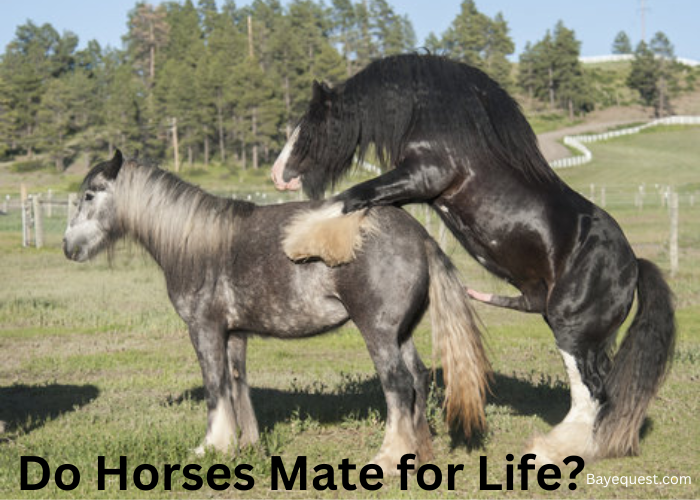
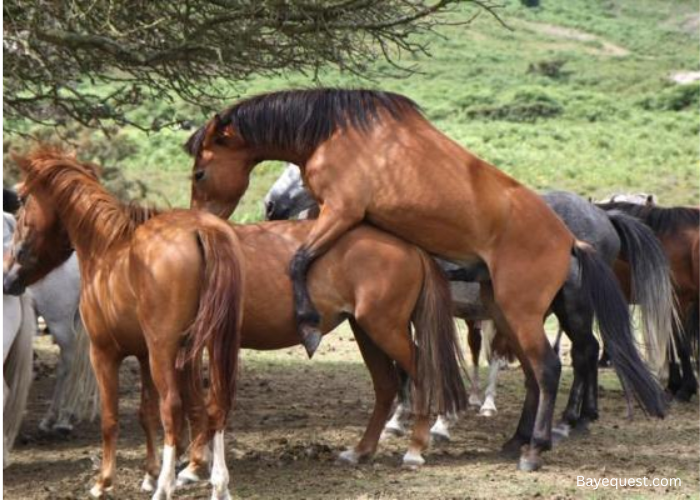
Once the mare is receptive, the stallion mounts her from behind in a brief but direct mating process. Copulation usually lasts less than a minute, during which the stallion ejaculates and fertilizes the mare’s egg.
Read more on how horses mate here – Steps of Horse Mating.
Do Horses Mate for Life?
The simple answer is no. Unlike certain animals, such as swans, wolves, or penguins that are known for forming lifelong pair bonds, horses do not mate with a single partner for life.
In the wild, a stallion typically mates with multiple mares within his herd. His goal is to pass on his genetics and protect the group, rather than forming an exclusive relationship with one mare.
Likewise, mares are not bound to one stallion for life. Over the course of their lives, they may belong to different herds and breed with more than one stallion, depending on circumstances such as herd changes, dominance battles, or environmental shifts.

Horse Mating Behavior in the Wild Vs Domestic Settings
The mating dynamics differ significantly depending on whether the animals live in the wild or under human care.
In natural environments, breeding is guided entirely by instinct and social dynamics. Stallions maintain a harem of mares and foals. He defends this group from rivals and predators, and, in return, gains exclusive breeding rights with the mares.
Courtship may involve nuzzling, vocal calls, and ritualized behaviors, during which the stallion demonstrates his strength and persistence. The mares, while receptive during heat cycles, still maintain the ability to accept or reject his advances.
This natural process balances dominance with choice, ensuring that only strong, protective males pass on their genetics.
Meanwhile, in domestic settings, human management plays the central role, often overriding the choices horses would make on their own.
On stud farms, stallions are carefully selected for their pedigree, conformation, or performance traits.
For example, mares may be matched to a stallion for economic or genetic reasons, regardless of whether they would have chosen him naturally.
In many cases, artificial insemination replaces natural mating altogether, allowing breeders to spread a stallion’s genetics across hundreds of mares worldwide.
Things You Should Know About Mating Bonds Between Stallions and Mares
At first glance, the mating habits give the impression of close, lasting partnerships between stallions and mares. After all, in the wild, a stallion often spends years with the same group of mares, defending them and raising foals alongside them.
But while these bonds may look similar to lifelong pairings, they are actually based on herd dynamics rather than true monogamy.
A dominant stallion typically guards a harem that can range from just a few mares to a dozen or more. Within this group, he mates with the mares and provides protection.
These relationships can appear stable, but they are not permanent. Rival stallions frequently challenge for control of a herd, and if the challenger succeeds, the leadership – and mating rights – change hands.
Mares, too, show loyalty more to their social group than to an individual male. They may form strong companionships within the herd, often with other mares or with their foals. But if a stallion is displaced or the herd splits, mares adjust to the new structure.
That said, bonds between stallions and mares can still be meaningful. A stallion may develop strong protective instincts toward his mares, and mares may display comfort and familiarity around him.
These bonds, however, are situational and temporary, shaped by dominance, reproductive cycles, and herd security rather than permanent affection.
It’s also worth noting that in domestic settings, stallion–mare bonds can look even less stable. Because humans control breeding pairings, a mare may be matched with many different stallions over her lifetime, often with little social interaction.
This reinforces the fact that mating in horses is less about exclusivity and more about biology and circumstance.
Do Horses Form Emotional Bonds?
Yes. While horses don’t mate for life, they are highly capable of forming deep emotional connections.
These bonds, however, are rooted in companionship and herd interaction rather than exclusive reproductive pairings.
For instance, within a herd, horses often develop long-lasting friendships. Mares may stay close to one another, grooming and resting side by side. Meanwhile, foals often form playful partnerships with peers that sometimes last into adulthood.
Even geldings, who no longer reproduce, establish strong bonds with companions, showing that affection among horses extends beyond mating behavior.
These relationships are built on trust and familiarity. Horses that spend significant time together often show clear signs of attachment, such as nickering when separated, mutual grooming, or standing close for comfort.
Such behaviors demonstrate that horses do experience companionship, even if it doesn’t translate to lifelong romantic bonds.

Bursting Horse Mating Myths and Misconceptions
Because horses are admired for their beauty, power, and grace, people often project human emotions and ideals onto them, many of which are completely untrue.
Let’s burst some common misconceptions.
Myth 1: Horses mate for life
One of the most persistent myths is that horses mate for life, much like swans or wolves are said to do. While this idea is romantic, it doesn’t reflect the reality of horse behavior.
A common misconception comes from the sight of a stallion with a consistent group of mares. To the casual observer, this appears to be a committed partnership.
In truth, the stallion is protecting a harem, not forming an exclusive lifelong bond. If another stallion takes over, the mares accept the change and continue life within the new structure.
Myth 2: Horses choose “soulmates”
Popular culture, films, and even some children’s books have painted horses as romantic creatures who fall in love like humans and even have “soulmates.”
However, in reality, what appears to be affection is often simply companionship, instinct, or a natural aspect of herd dynamics. Horses form strong friendships, yes, but not exclusive pairings.
How To Manage Horse Breeding Effectively: Barn Management Tips
Unlike in the wild, where horse breeding is driven by instinct, competition, and natural selection, domestic owners must constantly seek ways to produce desired qualities. You have three broad breeding options;
Stud farms
One of the most common practices is the use of stud farms, where stallions are selected for their pedigree, performance, or appearance.
Their genetics are carefully tracked to ensure bloodlines remain strong, especially in breeds prized for racing, endurance, or showing.
Artificial insemination
Artificial insemination allows breeders to control pairings with precision, eliminate the risks of natural mating injuries, and spread a stallion’s influence across the globe.
Unfortunately, while this method maximizes efficiency, it removes all natural mate choice.
Selective breeding
Humans also use selective breeding to enhance traits like speed in Thoroughbreds, stamina in Arabians, or strength in draft horses.
These decisions prioritize market demand, performance goals, or aesthetic standards rather than the instinctual factors that guide horses in the wild.
Of course, managed breeding doesn’t erase the horse’s natural instincts. Stallions may still display courtship behavior, and mares can still show preference, but these elements often play a secondary role to human decision-making.
Do Horses Mate for Life? Conclusion
The answer is clear: no, they don’t. Unlike swans or wolves that form lifelong pair bonds, horses follow a more flexible reproductive system shaped by herd dynamics, survival, and genetic diversity.
That said, horses are far from emotionless. In the natural environment, they form strong social bonds with their foals, companions, and sometimes with humans, which last for years and provide comfort and security.