



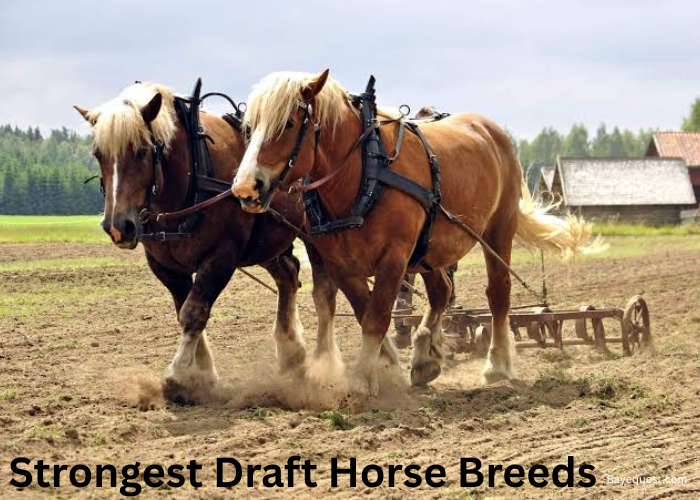
On October 4, 1981, at the Deerfield Fair in New Hampshire, a pair of Belgians weighing 4,350 lb combined dragged a 22,000 lb sled 66 inches across dry clay. That is about five times their own body weight.
UPI reported it as a new world horse-pulling record. It is also the best-documented pull we found while ranking the strongest draft horse breeds.
Now compare that with what gets repeated online. Two Shires moving 45 or 50 tons. Belgians “pulling 8,000 lb” as a matter of routine. Most of those numbers trace back to no source at all.
There is a second problem. Lists of the strongest horse breeds in the world use “strongest” three different ways: tallest, heaviest and best puller. Those are not the same horse.
So we set clear rules. We ranked these 10 breeds on documented pulling performance first, meaning contest records and how often the breed shows up in modern pulls.
Then we looked at body mass from breed-society standards. Last came build and the heavy work each breed was actually bred to do.
When a famous number can’t be traced to a primary source, we say so instead of repeating it.
One more note before the list. Every height and weight below comes from a breed society or registry standard, and individual horses vary widely. Heights are in hands (hh), and one hand equals 4 inches.
Top 10 Strongest Draft Horse Breeds in the World
1. Belgian Draft: The Breed That Holds the Pulling Records
Height: 16.2-17 hh (US) | Weight: 1,800-2,400 lb (Belgian Draft Horse Corporation) | Origin: Belgium (Brabant region)
That 22,000 lb Deerfield pull belongs to this breed. The team belonged to Dick Wallingford of West Forks, Maine.
The load was a flat sled stacked with 40 concrete blocks of 500 lb each, plus 10 men riding on top. A rival team hauled the same load only 58 inches, so Wallingford’s pair won by 8 inches.
That is the anchor. It isn’t the only Belgian number, though.
- Calgary Stampede Heavy Horse Pull: a pair of Belgians weighing 5,475 lb reportedly pulled 13,400 lb in 2012. That detail comes from a secondary source, so treat it as reported.
- The 17,000 lb pull: Avenue Calgary reports two Belgians weighing 4,800 lb combined moved 17,000 lb over 7 feet in 2014. Other sites place this pull at different events, so the location is shaky.
You can’t line these records up and pick a winner. One was measured over 66 inches, one over 7 feet and one over 14 feet, on different surfaces and sleds.
What you can measure is presence. Belgians are the most common breed in North American pulling contests, according to Horse Nation.
The Belgian Draft Horse Corporation says they outnumber all other US draft breeds combined. In 2026, the breed graduated off The Livestock Conservancy’s priority list entirely.
Build matters here too. The European Brabant type is heavier and squatter: stallions run about 2,000 lb, and horses over 2,200 lb are “not uncommon.”
American breeders started selecting for a taller, leaner horse in the 1920s. The Belgian breed society formed in Brussels in 1886, and the US association followed in 1887 in Wabash, Indiana.
Now the myth check. Other sites claim Belgians routinely pull 6,000 to 8,000 lb. We found no source for that, and Horse Nation puts a typical mid-contest load at around 5,000 lb.
And Brooklyn Supreme, the 3,200 lb, 19.2 hh Belgian stallion often cited as proof? He was an exhibition horse with no documented pulling feat.
Big Jake, the Belgian Guinness certified as the tallest living horse in 2010, holds a size record, not a strength record.
Strongest at: dead-weight sled pulls. It is the only breed on this list with a dated world-record pull.
2. Shire: The Heaviest Breed, With a Legend That Outruns the Evidence
Height: stallions 17.0 hh minimum, geldings 16.2, mares 16.0 (Shire Horse Society standard) | Weight: 1,870-2,430 lb (850-1,100 kg) stallions and geldings | Origin: England
You have probably read that two Shires pulled 50 tons at Wembley in 1924. It is the most repeated pulling story on the internet. But did it happen the way people say?
Start with what is solid. Guinness World Records named the Shire the largest horse breed in 2013.
The tallest horse ever recorded was a Shire gelding called Sampson, later renamed Mammoth, foaled in 1846. He stood 21.2½ hh.
His weight of about 3,360 lb is often quoted. It was an estimate, not a scale reading.
The work history holds up too. Shires pulled brewery drays loaded with ale. The English Cart Horse Society formed in 1878 and became the Shire Horse Society in 1884.
Now the legend. At the 1924 British Empire Exhibition in Wembley, the story goes, a Liverpool Corporation pair named Vesuvius and Umber moved a starting load “estimated at 50 tons.”
We flag it as unverified for four reasons:
- The versions conflict. Some say 45 tons, some say 50, and one says 29 tons for a single horse.
- The figure is described as beyond the dynamometer’s scale, so nobody actually measured it.
- Wikipedia carries the claim with a “citation needed” tag.
- We found no 1924 newspaper or society record to confirm it.
The line that “Shires pull over 8,000 lb” has the same problem. No source.
Modern evidence is thin as well. Shires make up only about 8% of the draft horses at the Calgary Stampede show, and Horse Nation’s guide to North American pulls names Belgians and Percherons, not Shires, as the contest breeds.
The breed is also scarce. The Rare Breeds Survival Trust lists it as “at risk,” and The Livestock Conservancy lists it as Critical.
That is why mass earns the Shire second place, but the legend doesn’t earn it first.
Quick comparison vs the Belgian: taller and heavier on paper, but the Belgian owns the documented pulls. No head-to-head test between the two breeds exists.
3. Percheron: The Contest Regular With Warhorse Roots
Height: 16.2-17.3 hh (US); French registry 15.1-18.1 hh | Weight: about 1,900 lb average (US) | Origin: France (Perche, Huisne valley)
In 1906 alone, more than 13,000 Percherons were imported into the United States. Why did American farmers want this horse so badly?
The answer starts with what the breed could do. Percherons descend from warhorse stock, then moved into stagecoach work and farm power.
The first imports reached the US in 1839, and only one of the four horses survived. Breed accounts trace every bloodline to a stallion named Jean le Blanc, foaled in 1823.
The American breed association grew out of the Norman-Percheron Association of 1876. The breed did well enough here that The Livestock Conservancy took it off its priority list in 2013.
What puts the Percheron at number three is contest evidence. Horse Nation’s guide to North American pulls names Percherons as the other breed competing alongside Belgians. At the Calgary Stampede draft show, Percherons make up 35% of the horses.
Here is the gap. We found no standalone pulling record for the breed, and that missing record is the main reason it sits behind the Belgian.
On mass, it comes close. An average US Percheron weighs about 1,900 lb, which lands inside the Belgian’s 1,800 to 2,400 lb range.
That combination is the case for third place: Belgian-class weight plus a regular spot in the pulling ring, which the Shire lacks.
The legs are heavily muscled, and the lower legs carry little or no feathering, unlike Shires and Clydesdales. One Percheron historian credits the breed’s popularity to its “strength, energy, activity, robustness and endurance.”
For hobby owners, those clean legs mean simpler leg care than on a feathered breed.
Best for: owners who want contest-grade power in an all-round farm horse.
Skip if: you specifically want a record-holding bloodline. That is Belgian territory.
4. Suffolk Punch: Shire-Level Weight on a Shorter Frame
Height: 16.1-17.2 hh | Weight: 2,000-2,200 lb (900-1,000 kg) | Origin: England (Suffolk)
Every Suffolk Punch alive today traces back to a single stallion. He was known as Crisp’s horse, foaled in 1768 near Woodbridge.
Here is the other surprise. A Suffolk weighs about what a Shire does, yet it stands shorter. Its 2,000 to 2,200 lb range sits squarely inside the Shire’s 1,870 to 2,430 lb band.
That is why we rank it this high. Taller doesn’t mean stronger, and in a dead pull, mass and leverage do the work.
The “punch” in the name describes the build: round, muscular, short-backed and broad through the chest. That low, deep frame lets the horse dig in against a heavy plow or load.
The breed was made for exactly that job. The Rare Breeds Survival Trust says it was developed specifically for the heavy clay soils of Suffolk and Norfolk.
The Suffolk has little or no feathering on its fetlocks, which keeps its legs cleaner in sticky clay. The coat is always chestnut.
The paperwork goes back a long way. The Suffolk Horse Society formed in 1877 and published its first stud book in 1880, making it the oldest English breed registry.
The breed is also in trouble. The Rare Breeds Survival Trust lists it as a Priority breed, and The Livestock Conservancy lists it as Critical. There were roughly 300 Suffolks in the UK in 2016.
We found no pulling records for the breed, and we won’t make one up. That gap is what keeps it out of the top three.
Among the strongest draft horse breeds, this is the one that most clearly proves height is the wrong yardstick.
The verdict: the strongest build per inch of height on this list. Only the absence of modern contest data holds the Suffolk back from the top three.
5. Clydesdale: Tall, Flashy and Built for Hauling, Not Just Parades
Height: 16-18 hh | Weight: 1,600-2,000 lb, largest up to 2,200 lb | Origin: Scotland (Lanarkshire / Clydesdale)
Most people only know this horse from a beer commercial. Its real job was much harder.
The Clydesdale came out of Lanarkshire in Scotland. From the mid-1700s, breeders crossed native mares with larger Flemish stallions.
The result worked the farms and handled heavy street haulage around Glasgow. The Clydesdale Horse Society formed in 1877, and the breed had already reached North America by then, with imports starting in the 1840s.
The breed’s modern presence is strong in one arena. Clydesdales make up 35% of the draft horses at the Calgary Stampede show, tied with Percherons.
That is show and hitch work, though, not pulling contests. Belgians and Percherons are the breeds you will find on the sled.
The beer connection is real, and it mattered. The Livestock Conservancy credits the Anheuser-Busch breeding program, running since 1953, as critical to the breed’s survival in North America.
Even so, the Conservancy lists the Clydesdale as Threatened, with fewer than 5,000 worldwide.
So why number five? It comes down to how the weight is spread. The Clydesdale is leggier and lighter-bodied for its height than the Suffolk or the Shire.
A Suffolk carries 2,000 to 2,200 lb on a frame topping out at 17.2 hh. A typical Clydesdale carries 1,600 to 2,000 lb on a frame that can reach 18 hh.
The strength is real. It is just stretched over a taller frame, and in a dead pull, height adds little.
Quick comparison vs the Shire: a similar height range, but the Shire carries about 230 lb more at the top end. Pick a Clydesdale for hitch work and showmanship.
Related read: Difference Between Draft Horses and Clydesdales.
6. Ardennais: The Ancient Artillery Horse Behind Other Draft Breeds
Height: about 16 hh (French standard: stallions 1.62 m, mares 1.60 m) | Weight: 1,500-2,200 lb (700-1,000 kg) | Origin: Ardennes (Belgium, Luxembourg, France)
In 1812, Napoleon’s army took Ardennais horses on its campaign into Russia to haul artillery. A century later, the breed did the same job again in World War I.
Hauling guns across a war zone is a brutal test of strength and stamina. The Ardennais passed it twice.
Its roots may go back further still. Breeders claim the Ardennais descends from horses of ancient Rome, though that is a breed claim rather than a documented line.
The modern record is clearer. The first breed registry opened in 1929, and France, Belgium and Luxembourg each keep separate studbooks today.
The strongest evidence for this breed is how often other breeders borrowed it. Ardennais blood helped build the Russian Heavy Draft, the Breton and the Dutch Draft, and you will meet two of those later on this list.
That repeated borrowing tells you what breeders thought the Ardennais added: weight and pulling power in a manageable frame.
The build explains why. The Ardennais is compact and heavy-boned. Its top weight of about 2,200 lb is close to the Belgian’s, yet it stands only about 16 hh.
That low, heavy frame still earns work today. The Ardennais is used in forestry, where machines can’t reach.
Like the Suffolk, it lacks modern contest data, which is why it sits in the middle of the list rather than near the top.
Strongest at: sustained hauling over rough ground, where a low, heavy frame beats height.
7. Breton: France’s Compact Heavyweight
Height: 15.1-16 hh | Weight: Trait Breton 900-950 kg (about 1,980-2,090 lb); lighter Postier type 750-900 kg (about 1,650-1,980 lb) | Origin: France (Brittany)
Here is a fast way to judge a draft horse’s power: look at how much weight it carries for each hand of height. By that test, the Breton punches well above its size.
The breed comes in two types, and only one earns this spot. The Trait Breton is the heavy draft type, while the Postier is lighter and was bred for coach and light draft work.
It is the Trait Breton that makes this list. It packs close to a ton of body weight, up to about 2,090 lb, onto a frame no taller than 16 hh.
Compare that with the Clydesdale back at number five, which carries 1,600 to 2,000 lb on a frame up to 18 hh. The Trait Breton’s top weight beats the typical Clydesdale’s on a horse up to two hands shorter.
The Breton studbook dates to 1909. Part of its power comes from Ardennais blood, the same foundation stock covered at number six.
Now the catch. In 2017, the breed recorded just over 2,300 new registrations, and most Bretons today are bred for meat.
That is why the breed has no modern work or contest record to push it higher. Its ranking rests on build alone.
Our recommendation: if you want to see how much power a short horse can carry, start with the Trait Breton.
8. American Cream Draft: The Only Draft Breed Developed in the US
Height: stallions 16-16.3 hh | Weight: stallions 1,800+ lb | Origin: Iowa, USA
An entire draft breed goes back to one cream-colored mare called Old Granny. She was seen at an Iowa auction in 1911. How does one horse become a breed?
Old Granny was foaled sometime between about 1900 and 1905. Breeders built on her line for decades, and the American Cream Association formed in 1944.
That makes this the only draft breed developed in the United States.
It is no lightweight. Stallions weigh over 1,800 lb, which puts the breed close to Percheron and Clydesdale territory on the scale. It carries that weight on a shorter frame, standing 16 to 16.3 hh.
So why only number eight? Rarity and missing evidence.
The breed recorded around 30 registrations a year as of 2004, the most recent figure we found. The Livestock Conservancy lists it as Critical.
With so few horses, there is no contest or haulage record to judge it on.
That is not a weakness of the horse. It is a lack of data.
A breed this small simply never gets tested against Belgians and Percherons in the pulling ring. Among the strongest draft horse breeds, the American Cream is the one with the most untested potential.
Best for: owners who want a rare heritage breed and a quieter project horse.
Skip if: you want proven contest bloodlines.
9. Dutch Draft: The Zeeland Clay Specialist
Height: stallions up to 16.3 hh (160 cm), mares about 155 cm | Weight: stallions about 750 kg (about 1,650 lb), mares about 700 kg (about 1,540 lb) | Origin: Netherlands (Zeeland)
Zeeland’s heavy clay and sand farmland needed a horse that would keep pulling through it. That is the ground this breed was made for.
Dutch breeders created the Dutch Draft by crossing Zeeland mares with Belgian Ardennes and Brabant stock. If those names sound familiar, they should.
That is the same Belgian family behind number one and the Ardennais at number six.
The breed society was founded in 1914. It received its royal title in 1948.
The result is deep-bodied and heavy-boned for its size. Other breed guides credit it with strength on clay and sand, the same conditions it was bred to handle in Zeeland.
Be careful with the bigger claims. Some sites call the Dutch Draft exceptionally strong, but we found no pulling data to back that up, so we won’t repeat it as fact.
Numbers are also small. There were about 1,424 Dutch Drafts in 2009.
Quick comparison vs the Belgian: it shares the bloodline, but a Dutch Draft stallion at about 1,650 lb is up to 750 lb lighter than a big US Belgian. That gap in mass is why it sits near the bottom of the list.
10. Jutland: Denmark’s Brewery Horse
Height: 15-16.1 hh | Weight: 1,430-1,760 lb (650-800 kg) | Origin: Denmark (Jutland peninsula)
Carlsberg has used Jutland horses since 1928. At its peak, the brewery kept 210 of them to haul its beer.
That is a serious working résumé. Brewery dray work means moving heavy, loaded wagons day after day, the same job Shires did for English breweries.
The Jutland stud book dates to 1881.
Then the tractors arrived. Denmark had about 15,000 Jutland horses in 1950. By 2011, that number had fallen to roughly 1,000.
So why does it close our list? On mass, it is the lightest breed here, at 1,430 to 1,760 lb.
The Comtois from France matches that exact weight range at 650 to 800 kg. The Jutland edges it out because of its documented heavy-wagon work, and a century of hauling loaded beer wagons through city streets counts as real evidence.
A few other breeds came close and missed. The Comtois, the Noriker and the Russian Heavy Draft all fell short on mass or measurable data.
The Russian Heavy Draft, for example, weighs only 580 to 700 kg and stands just 14.1 to 15 hh.
The verdict: strong for its size and a true working breed with a real haulage record. At roughly 1,500 lb, though, it can’t match the tonnage at the top of the list.
Strongest Horse Breeds in the World – FAQs
How much can a draft horse pull?
There are three answers, depending on the job. For all-day work, a horse can sustain about 1/10 to 1/8 of its body weight over a 20-mile day, based on 1920s dynamometer research by E. V. Collins at Iowa State College. On wheels, the Calgary Stampede says a fit horse can pull about three times its weight on a good road. In short sled pulls, teams in a peer-reviewed 2015 Calgary sample pulled 2.4 to 2.7 times their combined weight. The 1981 Deerfield record, covered in item 1, reached about five times team weight.
Can a horse pull 10 or 15 times its body weight?
No. We found no evidence for that claim. Measured data from Calgary shows teams pulling 2.4 to 2.7 times their weight in a sled contest, and lighter teams pulled more relative to their size than heavy ones. Even the Stampede’s own promotion claims “more than five times,” and the record-setting 1981 Deerfield Belgians pulled about five times their weight. That is the realistic ceiling for how much a draft horse can pull.
Is the Shire or the Belgian stronger?
On paper the Shire is bigger, and Guinness names it the largest horse breed. But the documented pulling records and contest dominance belong to the Belgian. No standardized head-to-head test between the two breeds exists, so the Belgian wins on evidence, not on size. See items 1 and 2 above for the full breakdown.
Did two Shires really pull 50 tons in 1924?
It is unverified. The Wembley story exists in conflicting versions of 45, 50 and 29 tons. The reading was said to be beyond the dynamometer’s scale, so no one measured it. We found no primary source from 1924, and Wikipedia flags the claim as needing a citation. Treat it as an exhibition legend rather than a record, and see item 2 above for the details.
What is the biggest horse ever recorded?
The tallest was Sampson, later called Mammoth, a Shire who reached 21.2½ hh by 1850. His estimated weight of about 3,360 lb was never confirmed on a scale. Brooklyn Supreme, a 3,200 lb Belgian, is sometimes called the largest, though that claim is disputed. Big Jake was the tallest living horse in 2010. None of the three has a documented pulling record, because being the biggest horse and being the strongest puller are two separate things.
Why aren’t Friesians or Fjords on this list?
Neither is a heavy draft breed. The Friesian is classed as a light draught horse, at 15 to 16 hh and 1,250 to 1,450 lb, and today it is used mainly for riding and driving. The Fjord is smaller still, at 13.1 to 14.3 hh and 880 to 1,100 lb. The Friesian only overlaps the very bottom of the Jutland’s range, the lightest breed ranked here, and the Fjord sits well below it.
Top 10 Strongest Draft Horse Breeds in the World – Conclusion
The strongest draft horses are not always the tallest or heaviest. What matters is proven pulling power, body mass, build, and real working history.
From record-setting Belgians to compact breeds like the Suffolk Punch, these horses show how strength takes many forms.