


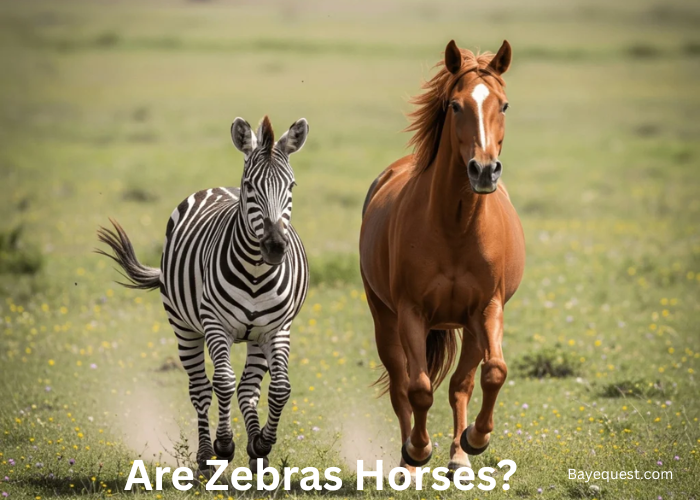
Horses and zebras are hoofed animals from the genus Equus. People admire them for their looks, speed, and the way they move in groups.
Zebras have a wild spirit and roam freely in woodlands and savannahs across Africa. Horses have been domesticated for thousands of years and are valued as human companions.
Although both equids share a common ancestor, they are different species. They differ in body shape and coat patterns, and they also exhibit distinct behavioral differences.
Read on to learn more about these closely related animals and why they remain so different.
Are Zebras Horses? Key Takeaway
No, Zebras are not Horses. Though Zebras and horses are both part of the Equidae family and share a common ancestor, they are different species. Horses have lived alongside humans for thousands of years, while zebras stayed wild. Due to their size, behavior, and temperament, zebras are more challenging to domesticate.
The Scientific Classification of Zebras and Horses
Examining their taxonomy and genetics reveals how closely related these quadrupeds are.
Family Ties: Taxonomy and Genetics of Zebras and Horses
Both horses and zebras belong to the Equidae family. These grazing mammals are built for speed and survival on open grasslands.
The Equidae family includes members of the genus Equus: zebras, horses, and donkeys. Horses are Equus ferus caballus, a domesticated subspecies of wild horse.
Zebras fall into three species: plains zebra (Equus quagga), Grevy’s zebra (Equus grevyi), and mountain zebra (Equus zebra).
Horses and zebras are closely related, but each has adapted to its own environment. Zebras live in Africa, where they use their stripes to camouflage themselves from predators. They also rely on their herds for protection.
Horses, on the other hand, evolved in Eurasia and were eventually domesticated.
Equidae Connections
The evolutionary history of equids dates back about 50 million years. The earliest known member of the Equidae family is Hyracotherium, a hoofed mammal that lived in forests before going extinct.
Over time, equids adapted to grasslands and became larger and faster. They developed single-toed hooves, ideal for running long distances.
Fossil records show that many equid species are now extinct. For example, the quagga, a subspecies of plains zebra, went extinct in the 19th century, but its genetic traces remain in museum samples.
Modern equids share a grazing diet, similar skeletal structure, and digestive systems adapted for fibrous plants.
Genetic Similarities and Hybrids
Zebras and horses share similar DNA, but their chromosome numbers differ. Horses have 64 chromosomes, while zebras have between 32 and 46. As a result, they rarely breed naturally, but hybrids are possible.
When zebras and horses are crossed, the offspring are called zorses and have some stripes. If zebras breed with donkeys, the result is a zonkey.
These hybrids, like mules, are infertile because their chromosomes do not match, indicating that zebras and horses are distinct species.

Meet the Animals
Zebras and horses may look similar at first, but they are distinct species that have evolved to inhabit different habitats.
What is a Horse?
The horse (Equus caballus) is a hoofed herbivore that has been a part of human history for millennia. It comprises a single species, which is categorized into different breeds.
The Botai, a hunter-gatherer group, were the first people to domesticate horses. For over 6000 years, humans have used horses for farming, hunting, transport, and combat.
They pulled plows through fields, carried traders along trade routes, and served as cavalry mounts in medieval Europe.
Today, horses are more than human companions. They play integral roles in recreation, sports, and therapy programs.
Horses can adapt to many situations, and their breeds come in different sizes and shapes. Thoroughbreds are fast, Arabians are known for endurance, and Shire horses are strong enough for heavy farm and industrial work.
Horses have strong, slender legs and solid hooves, which provide them with excellent balance. Their wide-set eyes help them spot danger almost all around.
Their bodies are built for running at high speeds, and they can maintain this pace for extended periods.
Horses are social and can form close bonds. They communicate with sounds and body language. Because they are easy to train and usually calm, people have been able to tame them.
What is a Zebra?
Zebras have never been domesticated like horses. Their black and white stripes make them easy to recognize, and each zebra has its own unique pattern, much like a fingerprint. The stripes help them hide from predators and also help control their body temperature.
The plains zebra is the most common and can be found in large herds across savannas and grasslands.
Mountain zebras stay in smaller groups and inhabit semi-arid regions and rugged highlands. The Grevy’s zebra is the largest of the three and features long ears with narrow stripes.
Behaviorally, zebras are social animals, but can also be unpredictable. Different species form harems or territorial systems. They form group vigilance that alerts the herd in the presence of predators.
Domesticating zebras is unattainable due to their sharp flight responses and unpredictable temper. They deliver strong kicks and sharp bites when defending themselves.
Are Zebras the Same as Horses?
Zebras and horses might look similar at first, but they have many differences. Both are part of the Equidae family, but they are separate species.
Horses have been bred by people for thousands of years, which has made them calmer and more suited to living with humans.
Zebras have always stayed wild. Their strong instincts and unpredictable behavior help them survive, but make them hard to domesticate.
Horses are usually taller and heavier, while zebras are smaller and built for speed. They also live in organized herds led by mares.
Zebra social groups vary by species. Some groups are composed of bachelor males, while others form harems or loose-knit bonds.
Although they are related, zebras and horses have evolved in their own distinct ways.
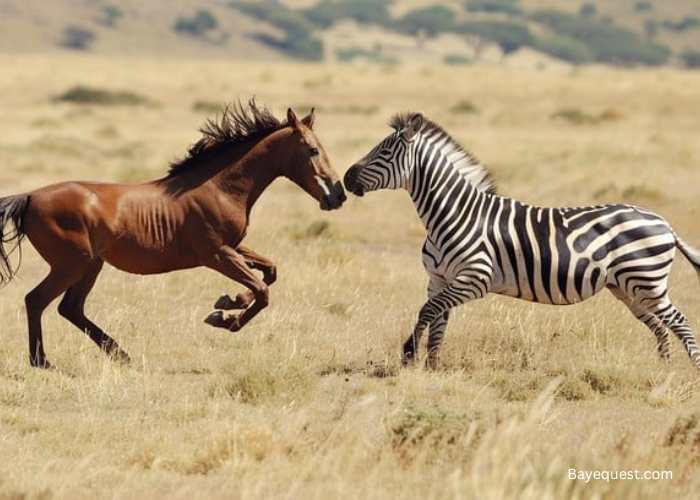
Horses Vs Zebras: What Are the Differences?
While horses and zebras share common features, you can easily differentiate them by:
Size, body, build, and gait
Horses are larger and heavier than zebras, with some breeds weighing up to 1,000 kilograms. Zebras are more compact, usually 10-13 hands tall and up to 300 kilograms, while horses can reach 17 hands.
Horses exhibit diverse gaits, such as cantering, galloping, and trotting, due to selective breeding for various purposes.
Zebras are built for quick sprints and can run up to 65 km/h, but their movement is not as smooth as a horse’s.
Coats and patterns
One big difference is their coats. Zebras have bold black and white stripes that help them hide and stay cool, and each zebra’s pattern is unique.
Horses come in many colors, such as black, white, brown, pink, or multicolored, due to selective breeding. Zebra stripes stay the same, but a horse’s color can change as it gets older.
Hooves and legs
Horses have long, slim legs, but zebras have shorter, sturdier legs. Both walk on single hooves. Horses need their hooves trimmed, and sometimes wear shoes to handle different jobs.
Wild zebras wear down their hooves naturally on rough ground. Their oval hooves help them move quickly, rather than carrying heavy loads.
Skull and teeth
Both species feature elongated skulls, which are well-suited for grazing. A horse’s face is elongated, while the zebra’s head is more robust. Both have continuously growing teeth to digest coarse grass and dry vegetation.
Morphology of ears, tail, and mane
Zebras have bigger, rounder ears than horses. Horses have long, hairy tails, while zebras have a solid tail with a tuft of hair at the end. A horse’s mane is long and flows down its neck, while a zebra’s mane is short, thick, and stands up like bristles.
Communication
Zebras and horses both use body language and sounds to communicate. Horses snort, neigh, and signal with their tails and ears.
Zebras make distinctive barks and brays to warn one another when predators are nearby quickly.
Domestication
People first domesticated horses about 4000 BCE in what is now Kazakhstan. Horses are more predictable and willing to work with humans, unlike zebras.
Wild horses can be nervous, but those raised by people are usually calmer. Zebras have strong instincts to run or fight, which is why they have never been domesticated.
Zebras are also not built for riding. They lack the gait to carry humans or run under saddles.
Temperament
People bred horses to be calm and easy to train. Zebras, on the other hand, stay aggressive when they feel threatened and defend themselves with bites and kicks. These behaviors help them survive in the wild.
Social structure
Horses live in groups led by a dominant female, while stallions protect the group. Grevy’s zebras form loose groups, with males defending their territory instead of the herd.
Plains zebras live in harems with one stallion, several mares, and their young. Young males often form bachelor groups until they join a harem.
Speed
Horses, especially thoroughbreds, are faster than zebras because they have been bred for racing. Horses can reach speeds of 55 mph, while zebras can run up to 40 mph. Zebras are very agile and often run in zigzags to escape predators like lions and cheetahs.
Diet
Both horses and zebras are herbivores, mainly grazing on grass. Zebras also consume shrubs and bushes during dry periods, while horses in captivity are often fed grains and other treats.
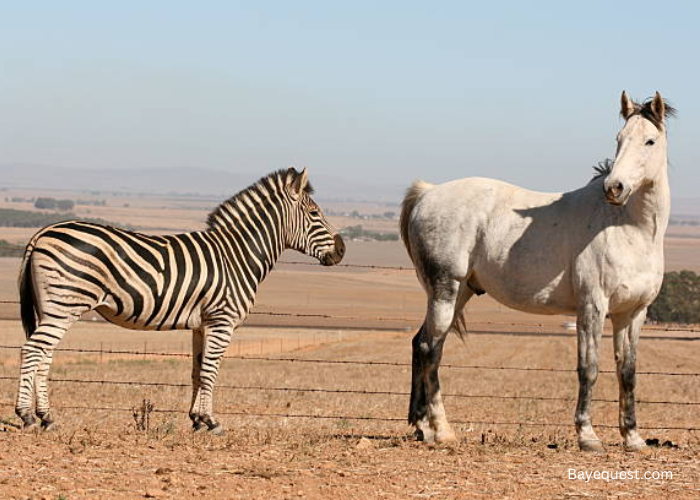
Habitats, Distributions, and Human Connections of Horses and Zebras
Let’s look at how horses and zebras fit into their environments.
Natural habitats
Wild horses were once common in Eurasia, but now only Przewalski’s horse survives in the wild. Domesticated horses live all over the world on farms and in stables.
Zebras, on the other hand, live only in Africa. Plains zebras roam the savanna, mountain zebras live in rocky highlands, and Grevy’s zebras are found in semi-arid areas.
Human impact
Horses have played a big role in human history, from pulling chariots and plows to serving in cavalry.
Zebras, however, have never been domesticated. Mountain zebras are especially at risk, and Grevy’s zebras are endangered, so people are working to protect their habitats.
Can Zebras and Horses Interbreed?
Zebras and horses can have offspring together, but these hybrids are always sterile. A zebra father and a horse mother produce a zorse, while the opposite pairing makes a hebra.
These animals exhibit traits from both parents, such as stripes and unique colors. Zorses are difficult to tame and are usually kept in captivity.
They are not used for work or as pets. Zebras can also breed with donkeys to make zonkeys. These rare hybrids demonstrate that zebras and horses are indeed distinct species.
Members of the same species should be able to produce a viable offspring. This is clearly not the case when horses and zebras are interbred.
Are Zebras Horses? FAQs
Is a giraffe a type of horse?
No, a giraffe is not a type of horse. Giraffes belong to the Giraffidae family, while horses are members of the Equidae. These two lineages diverged over 50 million years ago. Additionally, horses are odd-toed ungulates, while giraffes are even-toed. Giraffes are closely related to deer, cows, and okapis.
Is a donkey a horse?
No, a donkey is not a horse. Donkeys are a separate species in the Equus genus. They share ancestry with horses and zebras, but have different numbers of chromosomes. Donkeys have 62 chromosomes while horses have 64 chromosomes. This genetic difference results in sterile offspring. Additional differences include ear and tail length, coat color, mane, and behavioral traits.
Read also: How Long Do Donkeys Live?
Why can’t zebras be domesticated like horses?
Zebras can’t be domesticated because they’re aggressive and have an unpredictable temperament. Zebras lack the social hierarchy to accept leadership from humans. They’ll flee at the slightest sign of danger or resort to kicking and biting. Horses were selectively bred for docility, making them suitable for domestication.
Are zebras faster than horses?
No, zebras are not faster than horses. While zebras are swift and agile, horses tend to run faster. Some horse breeds have been selected for endurance and sustained racing. The fastest horse ever recorded clocked 55mph, while zebras can only manage 40mph.
Do zebras and horses eat the same food?
Yes, zebras and horses eat the same food. Both are herbivores and feed primarily on grass. However, horses in captivity receive grains, fruits, and treats. Zebras can digest less nutritious shrubs and tougher grass. This adaptation allows them to thrive when fresh grass is scarce. A balanced diet is essential for horses, and you may need to include mineral and vitamin supplements in their diet.
Can you ride a zebra like a horse?
No, you can’t ride a zebra like a horse. Zebras are wild animals with unpredictable behavior. Their backs are shorter, not built to carry a rider comfortably. They lack the domestication and calm temperament of horses. Zebras are skittish and defensive, which makes riding them unsafe and impractical compared to horses.
Are Zebras the Same as Horses? Conclusion
Zebras and horses are closely related and resemble each other, but they are distinct species. Horses have become important partners for people, helping build civilizations because they are easy to train and can carry heavy loads.
Zebras have stayed wild and rely on strong survival instincts. Each animal has adapted to its own environment. Even though zebras are not horses, people are still interested in whether they can be domesticated.